 By
By
When geography isn’t enough, ASN targeting lets you filter proxies by the actual network (ISP/carrier) behind the IP. That precision unlocks real ad verification, accurate QA, carrier-specific scraping, compliance and allowlisting that generic geo simply can’t match. In this guide, you’ll learn what ASN targeting is, when to use it, how to configure it, plus practical recipes, pitfalls, and a buyer’s checklist.
| Editor’s note: RapidSeedbox approaches this topic pragmatically. While it doesn’t expose a dashboard “ASN picker,” its Mobile Proxies use carrier/ISP-level routing (real 3G/4G/5G IPs), which often achieves the same network-parity outcomes discussed here. Residential and datacenter lines focus on geo + session control, providing ASN diversity by scale rather than ASN selection. |
TL;DR/Table of Contents
- ASN Targeting Explained: An ASN identifies a single operator’s network; sites often check ASN + geo + reputation to decide content, pricing, or access.
- Why ASN Targeting Matters: It enables ad creative parity, QA fidelity for risk checks, ISP-gated content access, clearer root-cause debugging, and fewer DC-fingerprint blocks.
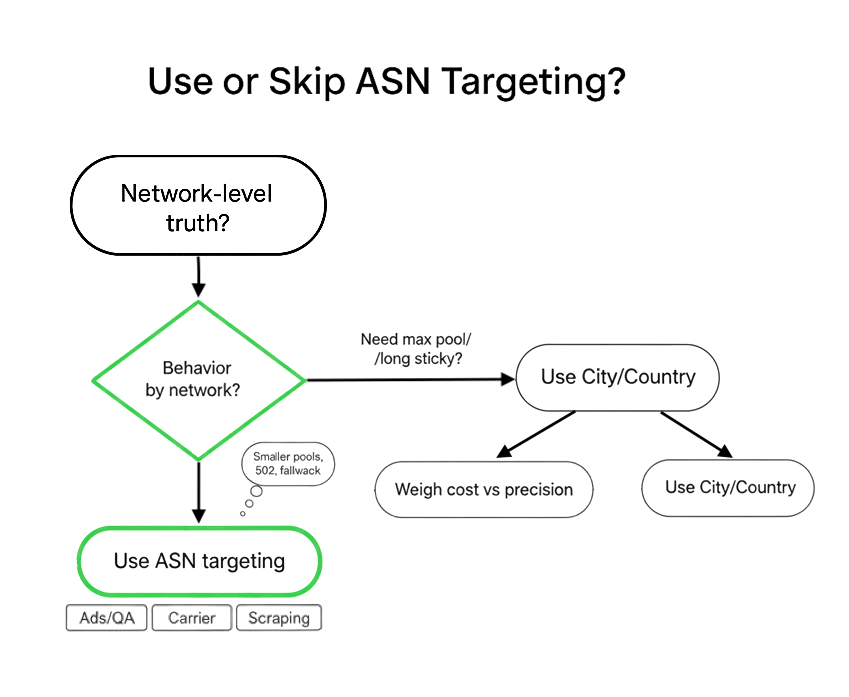
- When to Use / Skip: Use for carrier/ISP-dependent behavior and ASN allowlists; skip when throughput, stability, or cost outweigh precision or when experiences don’t vary by network.
- Proxy Types & Fit: Mobile = carrier targeting; Residential = common ASN/ISP filtering + breadth; ISP/Static Residential = strongest sticky; Datacenter = scale, limited ASN control.
- Find & Configure: Workflow: lookup ASN → auth/params → test (cURL) → code with retries/backoff → fallback chain (ASN→carrier→city→country); keep TTL and concurrency modest.
- Privacy & Compliance: Responsible use requires ethical sourcing, KYC/AUP, DPA + log policies, and per-ASN telemetry; regulations (e.g., GDPR/CCPA) may apply.
- FAQs: Mobile usually exposes carrier, not always ASN; 502/no-IP indicates pool scarcity; sticky stability depends on TTL, pool size, concurrency.
Content disclaimer: This article is provided for informational purposes only and does not constitute legal, compliance, or security advice. Proxy usage may be restricted by local laws, platform terms, and partner agreements. Capabilities and availability vary by provider and region. Always obtain proper authorization, follow applicable regulations (e.g., GDPR/CCPA), and respect robots.txt, rate limits, and acceptable-use policies.
1. ASN Targeting Explained (What You’re Actually Targeting)
“Geo says where you are. ASN says who you are on the internet.”
Most geo-targeting focuses on where an IP is, like what city or country it appears in. ASN targeting, on the other hand, focuses on who owns the network the IP belongs to, typically an ISP or carrier.
What does this mean? That means your proxy traffic gets routed through IPs linked to a specific network operator, identified by their Autonomous System Number (ASN). This can help your requests look like they’re coming from a trusted or allow-listed network, not just a general location.
Think of the difference like this: saying “I’m in Berlin” tells you where someone is. But saying “I’m on Telekom Deutschland’s network” tells you who they’re connected through — which can affect what pages or ads they see.
| 👉 Need a quick matrix? Jump to the “ASN vs City vs Country” table below. |
How it Works (refer to the diagram below)
- Client sends a request through a Proxy Gateway configured with a policy — for example: Target ASN = AS12345
- The Proxy Gateway forwards the request to the ASN Selector
- The selector chooses the matching network:
- 🟢 ISP A: AS12345 (Selected) → path that matches the target ASN
- ⚪ ISP B: AS67890 (Not Selected) → alternative network
- The chosen ISP’s IPs reach the Target Website / API, which checks:
- Geo location
- IP reputation
- ASN (network owner)
- If the ASN matches the site’s allowlist, the connection is accepted.

2. Why ASN Targeting Might Actually Matter
As mentioned in the previous section, most IP targeting looks at where someone is. ASN targeting goes deeper. It focuses on who owns the network (usually an ISP or carrier). That small shift can make a big difference depending on what you’re doing.
a. Ad Parity: See What Your Users See
If your campaign only runs on Carrier X, standard geo targeting won’t confirm delivery. ASN targeting makes sure your test traffic mirrors your users’ actual network, so you can verify ad placement and pricing directly.
b. QA Accuracy: Replicate Real-World Behavior
Some flows fail or trigger fraud checks depending on the IP’s ASN. For example, a checkout might break on a datacenter IP but pass on an ISP with sticky sessions. Testing with the right ASN helps you surface hidden issues and debug step-level failures more reliably.
c. Scraping Precision: Unlock ISP-Gated Content
Catalogs, prices, and landing pages often vary by network (not just location). ASN targeting lets you see what your users see on their real ISP, exposing content that generic IPs can’t access. One ASN might show a promo, another a login wall. That matters.
d. Compliance & Allowlisting: Avoid Network-Based Blocks
APIs and partner sandboxes often trust only specific ASNs. Using the wrong one can get you blocked. With ASN targeting, you cut down on those nasty 403s, 401s, and manual reviews by aligning with known-good network ranges.
e. Rate-Limit Resilience: Handle Load Smarter
Shared geo pools often throttle faster than smaller (higher-trust) ISP pools. By testing across ASNs, you can spot which networks hold up under pressure, fewer 429s and fewer 503s. And of course you get a more stable performance when it counts.
f. A/B Testing by Network: Separate the Signal
Not all user behavior differences come from location or device. ASN targeting helps you isolate network effects (like whether higher conversion is due to the ISP, not just the region). It’s a better way to get signal from your tests.
g. Debugging & Accountability: Trace the Root Cause
When errors spike, ASN segmentation helps you pinpoint the problem fast. If failures cluster on one ASN, swap it out or escalate directly. You’ll waste less time guessing and resolve incidents faster with clearer network-level insights.
h. Security & Trust: Look Less Like a Bot
Some platforms distrust DC IPs no matter how clean your headers are. ISP ASNs, especially with sticky sessions, look more like real users. That can mean the difference between a signup that works and one that silently fails.
ASN Targeting Proxies, Simplified 🔍
See how carrier/ISP-level targeting achieves the same network parity most teams seek from ASN controls—without extra knobs. Quiet, testable, compliant.
Explore mobile proxies3. When to Use ASN Targeting, and When to Skip It.
ASN targeting is a precision tool. We recommend the following:
Use ASN targeting when…
- You need carrier/ISP parity for ad verification or brand safety.
- QA requires reproducing network-specific behaviors (content toggles, payment risk checks).
- You’re scraping content where the ISP/carrier changes the experience (catalogs, prices, access).
- Access is gated by allowlists, and only certain ASNs can reach the endpoint reliably.
Skip ASN targeting when…
- You need maximum pool size and throughput for broad data collection.
- Cost sensitivity outweighs precision.
- You need consistent availability across long sticky sessions with heavy concurrency.
- The target service doesn’t vary by network—only by geo or device.
Trade-offs to acknowledge
First, using ASN filters means working with smaller pools. When you narrow traffic to a specific network, you naturally reduce the number of available IPs. Second, availability can vary. During peak times or high demand, you might hit errors like 502s or run into “no IP available” messages more often than with broader targeting.
Finally, ASN targeting requires more operational care. To keep things stable, you’ll need smart fallback logic—stepping down from ASN to carrier, then city, and finally country—as well as retry handling to smooth over gaps in availability.
ASN vs City vs Country Targeting (Quick Comparison)
| Targeting method | What it filters by | Precision for ISP/carrier logic | Typical pool size | Stability for sticky sessions | Typical cost | Best for |
| ASN targeting | Specific network (Autonomous System) | High | Low–Medium | Medium | Medium–High | Carrier/ISP parity, ad/QA |
| City targeting | City/location | Medium | High | High | Medium | Localized scraping, pricing |
| Country targeting | Country | Low | Highest | Highest | Low–Medium | Broad data collection |
🔑 Key takeaway: If you’re chasing network-level truth, ASN wins. If you’re chasing scale, city/country wins.
4. Which Proxy Types Support ASN Targeting (Know Your Tools)
Not all proxies handle network identity the same way. Some give you real ISP or carrier parity; others just push traffic through fast.
This section breaks down when ASN or ISP targeting actually matters; and which proxy types (like Residential, ISP, Mobile, or Datacenter) are built for the job.
Capability Matrix at a Glance
| Proxy type | ASN/ISP targeting | Carrier targeting | Session control (sticky) | Typical pool diversity | Notes |
| Residential | Often Yes | Sometimes | Sticky & rotating | High | Best balance for ASN filters |
| Mobile | Varies | Yes | Sticky & rotating | Medium | Dynamic; carrier-first targeting |
| Static residential (ISP) | Yes | Sometimes | Strong sticky | Medium | Stable IPs for QA; higher trust |
| Datacenter | Rare/limited | No | Sticky supported | High | ASN filters uncommon/limited |
- Residential proxies: Most supportive of ASN targeting with decent pool sizes.
- Mobile proxies: Strong carrier targeting; ASN support varies; pools can shift quickly.
- Static residential (ISP proxies): Great for sticky sessions and QA; precise but smaller pools.
- Datacenter: Fast and cheap, but ASN filtering is not the typical strength.
✅ Quick win: Start tests with residential; promote to static residential if you need stronger stickiness.
5. Find & Configure: From ASN Lookup to a Working Request (Copy-Paste Ready)
Let’s make this practical. You’ll go from zero to requests routed through a chosen ASN in minutes.
a. Step-by-step (5 Steps)
a.1. Find the ASN
- Use any ASN lookup (search: “ASN lookup”) or an ASN lookup API to map ISP/carrier → ASN.
- Validate with a second lookup if mission-critical. Some ISPs have multiple ASNs.
a.2. Confirm support
- Check your provider supports asn= in the auth string or API params for your proxy type.
- Note limits: some providers support ASN only for residential or static residential pools.
a.3. Build authentication
- Generic pattern (provider-agnostic example):
customer--asn- -country- -sessid- : - Add city-<CITY> or other flags if needed.
- Use sticky sessions (via sessid or TTL) when you need flow persistence.
- Remove sessid or add a “rotate” flag for rotating sessions.
a.4. Test via cURL
- Start simple. Test IP echo endpoints to verify routing and stability.
a.5. Integrate with code
- Add retry/backoff and fallback logic (ASN → carrier → city → country) for resilience.
b. cURL Examples (HTTP & SOCKS5)
Placeholders
<HOST> proxy host • <PORT> proxy port • <USER> your account name
<PASSWORD> proxy password • <ASN> target ASN (e.g., AS12345)
<CC> 2-letter country (e.g., US) • <SESSION_ID> any sticky token (e.g., uuid)
cURL — HTTP proxy (basic)
|
1 2 3 4 5 6 7 8 9 |
# HTTP over proxy curl -x "http://<HOST>:<PORT>" \ -U "customer-<USER>-asn-<ASN>-country-<CC>-sessid-<SESSION_ID>:<PASSWORD>" \ -H "User-Agent: Mozilla/5.0" \ -m 25 -sS https://httpbin.org/ip |
cURL — SOCKS5 proxy (hostname resolved by proxy)
|
1 2 3 4 5 6 7 8 9 |
# SOCKS5 over TCP; DNS resolved by proxy curl --socks5-hostname "<HOST>:<PORT>" \ -U "customer-<USER>-asn-<ASN>-country-<CC>-sessid-<SESSION_ID>:<PASSWORD>" \ -H "User-Agent: Mozilla/5.0" \ -m 25 -sS https://httpbin.org/ip |
Python — requests with sticky session + exponential backoff
|
1 2 3 4 5 6 7 8 9 10 11 12 13 14 15 16 17 18 19 20 21 22 23 24 25 26 27 28 29 30 31 32 33 34 35 36 37 38 39 40 41 42 43 44 45 |
import os, time, random import requests HOST = os.getenv("PROXY_HOST", "<HOST>") PORT = os.getenv("PROXY_PORT", "<PORT>") USER = os.getenv( "PROXY_USER", "customer-<USER>-asn-<ASN>-country-<CC>-sessid-<SESSION_ID>", ) PASSWORD = os.getenv("PROXY_PASS", "<PASSWORD>") PROXY = f"http://{USER}:{PASSWORD}@{HOST}:{PORT}" session = requests.Session() session.proxies.update({"http": PROXY, "https": PROXY}) session.headers.update({"User-Agent": "Mozilla/5.0"}) def get_with_backoff(url, attempts=5, base_sleep=1.0, jitter=0.25): for i in range(attempts): try: r = session.get(url, timeout=25) if r.status_code == 200: return r # Retry on rate/edge errors if r.status_code in (429, 502, 503): time.sleep(base_sleep * (2 ** i) + random.uniform(0, jitter)) continue r.raise_for_status() return r except requests.RequestException: time.sleep(base_sleep * (2 ** i) + random.uniform(0, jitter)) raise RuntimeError( "Failed after retries — consider fallback (ASN → carrier → city → country) " "or shorter session TTL." ) if __name__ == "__main__": print(get_with_backoff("https://httpbin.org/ip").text) |
Notes
- Sticky sessions: keep <SESSION_ID> constant to reuse the same egress IP; change it to rotate.
- ASN fallback: if AS allowlist is tight, try alternate ASNs or relax to carrier/city/country.
- DNS: use –socks5-hostname to ensure domain lookups happen through the proxy.
| ⚡ Common mistake: Long sticky TTL + ASN filter + high concurrency. Fix: Shorten TTL, stagger requests, and pre-check availability for the target ASN. |
c. Troubleshooting (keep this handy)
One common issue is a 502 or “no IP available” error. It usually means the pool for that ASN is maxed out. Let the client wait before retrying—exponential backoff helps. If retries keep failing, fall back gradually: first to carrier, then city, then country. Keeping concurrency low and session TTL short also eases the pressure on small pools.
Another problem shows up during sticky sessions. If too many threads fight for the same few IPs, the proxy runs dry. Fewer parallel sessions, shorter TTLs, and breaking the work into smaller bursts can help. It’s also smart to check pool availability before heavy tests so you’re not flying blind.
| ✅ Quick win: Track success rate, median response time, and 5xx rates per ASN. Alert on spikes. |
6. Privacy, Compliance & Buyer’s Checklist (Keep Legal Safe and Ops Sane)
If ASN targeting is the scalpel, compliance is the hand that holds it steady.
Why? You’re sending traffic through networks you don’t own, so proof of ethics and operational transparency is really the foundation that keeps your program alive when audits, blocks, or complaints arrive.
What to verify with providers
- ASN/ISP filter support by proxy type (residential, ISP/static residential, mobile).
- Session control: sticky duration/TTL, session reuse, termination hooks.
- Coverage: which ASNs/carriers are supported in your target countries/cities.
- Pool telemetry: historical availability, success rates, error codes for chosen ASNs.
- Protocols & PoPs: HTTP/HTTPS/SOCKS5; regional points of presence.
- Ethical sourcing: user consent, acceptable-use policy, KYC.
- Compliance: GDPR/CCPA, DPA availability, log retention defaults/options.
- Limits: rate limits on ASN-filtered traffic; trial constraints before commitment.
Highlight: “A credible provider can show pool availability and success rates for your specific ASN short-list, before you scale.”
| 🔑 Key takeaway (make-or-break signals) Don’t take claims at face value, ask for per-ASN data and a DPA. Confirm where the data comes from with an ethical sourcing statement and KYC controls. Test everything on your own ASNs before trusting it, tracking success rates, and errors. Finally, document your guardrails, TTL, concurrency, fallback order, and rate limits, in your runbooks. |
7. FAQs: ASN Targeting Proxies
It’s filtering your proxy connection by Autonomous System Number, which effectively means choosing which ISP/carrier network your traffic appears to come from—not just the geography.
Use ASN when network identity changes what you see (ads, flows, content). Use city when you need larger pools and stable availability with less precision.
Most mobile pools emphasize carrier targeting. Some support ASN, but availability is dynamic. Validate the ASN in your target country/city before committing.
Your ASN pool may be temporarily exhausted. Add retries/backoff, reduce concurrency, shorten sticky TTL, and implement a fallback chain (ASN → carrier → city → country).
Right-size TTL, keep concurrency modest, and watch pool telemetry. If you only need request-level parity, switch to rotating for scale.
We don’t expose a dashboard ASN picker. For most outcomes, Mobile (carrier/ISP-level) delivers the same parity; Residential improves acceptance on sensitive flows. If you’re strictly allow-listed by a specific ASN, we’ll run a quick pilot and recommend the best path.
We optimize for scale, reliability, and compliance. You still get ASN diversity by scale without managing network-engineering knobs.
8. Final Words.
Geo-only targeting often misses what truly shapes user experience: network identity. Content can change by ISP/carrier/ASN. This leads to false negatives in QA and inconsistent scraping results.
Use ASN targeting (or carrier/ISP-level routing via mobile or residential pools) to align tests with the networks your users actually traverse. Configure sticky or rotating sessions, validate availability, add retries and fallback chains (ASN → carrier → city → country), and track per-ASN performance to keep systems stable and compliant.
Quick summary
- ✅ When to use: Ad verification, carrier-sensitive QA, ISP-gated content.
- 🔁 How to run: Lookup ASN, configure auth, add backoff + fallback, monitor pool health.
- ⚖️ Trade-offs: Smaller pools, variable availability; balance precision vs scale.
- 🧰 Tools: Residential/ISP/mobile for parity; datacenter for throughput.
- 🛡️ Compliance: Ethical sourcing, KYC/AUP, DPA, and clear log policies.
- 📈 KPIs: Success rate, 5xx/429, latency, and variant coverage per network.
In short: Treat network identity as a first-class signal. Apply precision where it matters and scale where it helps.
See Carrier Parity In Action 🔬
A brief test on a single carrier can reveal whether ads, pricing, or flows change by network—before you scale anything.
Run one check
0Comments