 By
By
IPv6 proxy pricing is quickly changing the math for business data operations. Instead of fighting over a shrinking pool of expensive IPv4 addresses, companies can now access virtually unlimited IPv6 proxies at a fraction of the cost. This guide walks through the main categories—residential, datacenter, mobile, and hybrid setups—using real pricing examples from leading US and EU providers. You’ll see where IPv6 saves money, how it scales for large scraping jobs, and why hybrid solutions matter for sites that still rely on IPv4. By the end, you’ll know which proxy type makes the most sense for your needs.
Table of Contents
- Introduction
- How proxy billing actually works (quick math)
- Residential IPv6 Proxies Pricing
- Datacenter IPv6 Proxies Pricing
- Mobile IPv6 Proxies Pricing
- Hybrid IPv6/IPv4 Proxy Setups
- Use Case Evaluation: Choosing the Right Proxy
- FAQ: IPv6 Proxy Pricing in 2026
- Conclusion
Content Disclaimer: This article is for informational purposes only. Pricing, provider details, and features are based on publicly available data as of 2026 and may change over time. Always verify with the provider before making purchasing decisions.
1. Introduction.
In 2026, IPv6 proxies have become the cost-effective answer to IPv4’s rising limitations. With an almost endless supply of IPv6 addresses (3.4×10^38 compared to just ~4 billion IPv4), providers can now deliver massive proxy pools at far lower prices.
Learn more in: Why Are We Currently Undergoing a Switch from IPv4 to IPv6?
So why now?
Major services like Google, social networks, AI platforms, and e-commerce sites already support IPv6. And the best part is: Prices run anywhere from 3 to 20 times cheaper than IPv4, and the IPs themselves are often “cleaner” since they’ve seen less prior abuse. The only catch is compatibility—not every site fully supports IPv6 yet. That’s where hybrid setups come in to be quite handy. The help in combining IPv6 for cost savings with IPv4 as a reliable fallback.
2. How proxy billing actually works (quick math)
Proxy providers don’t all charge the same way. Some bill you by the gigabyte (GB), others by the IP, port, or even by the request. Each model fits a different job, so knowing the basics helps you avoid overpaying.
- Per GB: Cost = GB used × rate. (Many vendors discount with monthly commitments; PAYG exists—e.g., Oxylabs PAYG per-GB—and committed plans lower the per-GB price.)
- Per IP/month: Cost = #IPs × price/IP × months. (Common for static ISP/“residential ISP” proxies and datacenter proxies.)
- Per port: Cost = #ports × monthly rate. Bandwidth is typically unlimited; rotation interval is fixed (e.g., every 5–30 min).
- Per request: Cost = (successful requests ÷ 1,000) × price/1k, with different tiers for plain HTTP vs. full browser rendering.
Here is a comparison table with more detail:
| Model | What you’re paying for | Best suited for | Pros | Cons |
| Per GB (metered) | Data transferred | Rotating residential & mobile scraping | Flexible, scalable | Costs rise with heavy use |
| Per IP / per proxy | Fixed static IPs | Long sessions, account mgmt, allowlists | Predictable cost, sticky IPs | Must commit to # of IPs |
| Per port / thread | Access ports to a rotating pool | Budget scraping, unmetered tasks | Simple, cheap, unlimited BW | Less control, smaller pools |
| Per request | Successful HTTP/Browser requests | Hard targets with bot protection | Pay only for successes | Costlier per page |
Quick Chooser
- Need massive coverage + flexibility? Go per GB (rotating residential/mobile).
- Need long-lived, stable sessions or allowlisting? Go per IP (static ISP/residential or DC).
- Need ultra-low cost, unmetered bandwidth for simple targets? Try per port.
- Need highest success on protected sites with predictable per-page cost? Choose per request (smart proxy/unblocker).
| 💡 Pro tip: Some providers offer PAYG to get a feel for your usage. Once you know your monthly GB or IP needs, you can negotiate a committed plan. For example, Bright Data lets you choose pay-per-IP or pay-per-GB with no hidden geo/domain costs. |
3. Residential IPv6 Proxies Pricing
Residential IPv6 proxies run traffic through real consumer ISP connections, which makes them look like genuine home users. That trust factor (especially if you are scraping) is critical. Websites are far less likely to flag you. These benefits make these proxies a strong choice for scraping sites that usually block datacenter IPs. They also make them perfect for managing multiple social media accounts, verifying ads, or testing localized content.
Still, residential IPv6 proxies remain a niche in 2026. Only a handful of providers offer them, and pricing varies widely depending on whether you need static IPs or rotating pools. Pricing also varies whether billing is per IP or per gigabyte.
Key Providers
- Oxylabs: Oxylabs’ Rotating IPv6 Residential Proxies provide access to a vast pool of 175M+ premium IPv6 addresses with 99.9% uptime, ~0.6s response time, and 99.95% success rates, supporting unlimited bandwidth, concurrent sessions, automatic rotation, free geo-targeting, and 24/7 support with dedicated account managers. Pricing starts at $99/month for 13GB ($7.75/GB), scaling to $300/month for 40GB ($7.50/GB) and $600/month for 86GB ($6.98/GB), with custom enterprise plans beyond 1TB; yearly commitments offer a 10% discount, making larger plans more cost-efficient. Learn more: Oxylabs Review + Alternatives
- Proxy-Cheap: Proxy-Cheap offers a wide range of proxy types with a strong focus on affordability and scale. They include static and rotating residential, mobile, and datacenter options across 180+ global locations. Their IPv6 static residential proxies (ISP) come from trillions of US-based IPs with dedicated addresses, unlimited bandwidth, and support for 100 threads, starting at $0.70 per proxy/month and discounted down to $0.52 with bulk purchases (500 proxies). Learn more: Proxy-cheap Review + Alternatives
- V6Proxies: V6Proxies specializes in IPv6 proxy services with both static and rotated residential options, offering unlimited bandwidth, HTTPS/SOCKS5 support, and strong leak protection features (no DNS/IPv6 leaks, footprint protection). Their static IPv6 residential plan is the Bronze tier at $400/month for 4,000 proxies (delivered as single IPs per /48 subnet), while rotated residential plans include Stinger at $1,000/month with a 1M IP pool and BrokenArrow at $2,200/month with a 4M IP pool, both delivering new IPs per request and supporting full anonymity with user/pass or IP authentication.
Pricing Comparison Snapshot
| Provider | IP Pool / Scale | Pricing | Key Features | Best For |
| Oxylabs | 175M+ rotating IPv6 | From $99/mo ($7.75/GB) | Unlimited BW, 99.9% uptime, geo-targeting | Enterprise scraping |
| Proxy-Cheap | Billions static IPv6 (US) | $0.70 → $0.52/proxy/mo | Dedicated IPs, unlimited BW, bulk discounts | Low-cost scaling |
| V6Proxies | 4K static / 1–4M rotated | $400–$2,200/mo | Unlimited BW, HTTPS/SOCKS5, leak protection | Anonymity + big pools |
📌 Standardization Note on Pricing
These proxy providers use different billing models, so prices aren’t directly comparable: Oxylabs → Per GB traffic. Proxy-Cheap → Per proxy/month. V6Proxies → Flat monthly tiers.
Key points to remember:
- Per GB (Oxylabs) = cost scales with usage.
- Per proxy/plan (Proxy-Cheap, V6Proxies) = flat unlimited bandwidth, better for heavy traffic but quality/pool depth vary.
Why the big pricing gap between Proxy-Cheap and V6Proxies? Proxy-Cheap is “good enough” for cheap scaling if you just need lots of static IPv6 addresses. V6Proxies justifies its premium by bundling better anonymity, larger rotated pools, and leak protection—things Proxy-Cheap doesn’t prioritize.
| Final Verdict: Residential IPv6 proxies are niche, but when you need them, they deliver. Oxylabs is the enterprise pick—reliable uptime and global scale. Proxy-Cheap is the budget play for bulk static IPv6 with unlimited bandwidth. V6Proxies charges more. But its huge rotating pools and strong privacy justify the premium. |
4. Datacenter IPv6 Proxies Pricing
Datacenter IPv6 proxies are the cheapest and most abundant option in 2026. Thanks to the massive IPv6 address pool, providers can hand out huge ranges for just pennies per IP—usually with unlimited bandwidth included. They’re best suited for high-volume scraping, SEO tracking, automation, and testing—anywhere cost and scale matter more than looking like a real residential user.
Key Providers
- RapidSeedbox: Market leader for cost-efficient datacenter IPv6. Pricing starts at $15/month for 100 IPs (~$0.15/IP) and drops as low as $0.02/IP at 50,000 proxies. All plans include unlimited bandwidth, 99.99% uptime, and HTTP(S)/SOCKS5 support. Ideal for enterprises that need massive scale without heavy budgets.
- Proxy-Cheap: Straightforward pricing at $0.20/IP or $0.15/IP on long-term plans. Includes unlimited bandwidth and support for high concurrency. A practical entry point for smaller scraping or monitoring projects.
- Proxy-Seller: Offers flexible geo-targeting with pricing starting from $0.08/IP (varies by region and contract length). Includes 1 Gbps speeds and both HTTP(S)/SOCKS5 protocols. Great for teams that need location diversity at a low per-IP cost.
- Oxylabs: Premium option with enterprise-grade infrastructure. Pricing ranges from $2.25/IP at small scale down to $1.20/IP for 1000+ IPs. Plans include unlimited sessions, compliance guarantees, and coverage across 188+ locations. Best suited for companies where support, SLAs, and global reach matter more than price.
Comparison Snapshot
| Provider | Price Range (per IP) | Bandwidth | Notes |
| RapidSeedbox | $0.15 → $0.02 | Unlimited | Best cost-efficiency; scales to 50k IPs |
| Proxy-Cheap | $0.20 → $0.15 | Unlimited | Budget choice; simple pricing |
| Proxy-Seller | From $0.08 | Unlimited | Flexible geo-targeting, fast connections |
| Oxylabs | $2.25 → $1.20 | Unlimited | Enterprise-grade; 188+ global locations |
📌 Standardization Note on Pricing
Datacenter IPv6 proxies are usually sold per IP/month with unlimited bandwidth. Still, providers differ in scale, features, and positioning:
- RapidSeedbox → $0.15/IP at entry, dropping to $0.02/IP at 50K scale. Industry leader in bulk cost-efficiency.
- Proxy-Cheap → $0.20/IP or $0.15/IP on long-term plans. Straightforward budget option.
- Proxy-Seller → From $0.08/IP, with pricing tied to region and contract length. Adds geo-targeting flexibility.
- Oxylabs → Premium pricing from $2.25/IP → $1.20/IP at 1000+ IPs, with enterprise SLAs, compliance, and 188+ locations.
Key points to remember!
- All providers offer unlimited bandwidth, so price per IP is the main comparison metric.
- Best fit depends on priorities: lowest bulk cost (RapidSeedbox), entry-level affordability (Proxy-Cheap), geo diversity (Proxy-Seller), or enterprise reliability at a high cost (Oxylabs).
| Final Verdict: Datacenter IPv6 proxies are the cheapest and most scalable option in 2026. They are ideal for high-volume scraping and automation. Proxy-Cheap offers simple entry-level pricing, but Proxy-Seller adds affordable geo diversity. Oxylabs provides enterprise-grade infrastructure at a premium, RapidSeedbox stands out for delivering the best balance of reliability and cost-efficiency—scaling from $0.15/IP down to just $0.02/IP with unlimited bandwidth and 99.99% uptime, making it the most practical choice for large-scale use cases. |
5. Mobile IPv6 Proxies Pricing
Mobile proxies route traffic through carrier networks—3G, 4G, 5G—which makes them some of the most trusted IPs available. Sites treat them like real phone users, which is why they’re so valuable for social media automation, geo-targeting activities like ad verification, and app testing. In theory, as carriers roll out IPv6 by default, mobile IPv6 proxies should carry the same trust—just with cheaper and cleaner addresses.
The Provider Gap
Here’s the catch: in 2026, there isn’t really a retail market for mobile IPv6 proxies. Major providers like Rapidseedbox, Oxylabs, Proxy-Cheap, and TheSocialProxy all offer mobile proxies, but none publicly disclose IPv6 connectivity. Their documentation still leans heavily on IPv4.
The reason? Mobile networks often run on Carrier-Grade NAT (CGNAT) or dual-stack setups where IPv6 exists but isn’t consistently exposed in proxy infrastructure. Vendors could deliver IPv6 mobile proxies, but usually only as a custom enterprise deal (the kind you’d have to negotiate directly with sales.)
Final Take
For now, mobile IPv6 proxies remain the missing piece. If your project requires them, your only path is working with a premium vendor’s enterprise team for a custom build. For most businesses, the more practical play is hybrid:
- Use mobile IPv4 proxies where trust and authenticity are critical.
- Pair them with residential or datacenter IPv6 proxies for scale and cost efficiency.
| 👉 Bottom line: Mobile IPv6 isn’t ready for the mass market in 2026. Plan your proxy stack with IPv4 mobile plus IPv6 elsewhere until carriers and providers fully align. |
6. Hybrid IPv6/IPv4 Proxy Setups
Hybrid proxy setups combine IPv6 and IPv4 to cover more ground at a lower cost. The model is simple: lean on cheaper IPv6 proxies whenever possible, then fall back on IPv4 only when a site doesn’t support IPv6. This balance keeps costs down without leaving blind spots.
Here is how the hybrid IPv6/IPv4 proxy setup works:
Refer to the image below. The hybrid IPv6/IPv4 model routes traffic through a central gateway, which decides whether to send each request to an IPv6 or IPv4 pool. This setup covers all target types—IPv6-only, IPv4-only, and dual-stack sites.
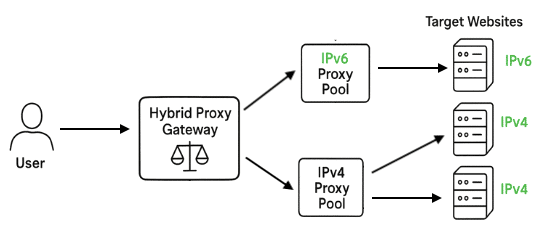
You get the scale and lower cost of IPv6, without losing compatibility with IPv4 services. In practice, it’s a balanced approach: efficient, cost-friendly, and reliable for large-scale web tasks.
Common Approaches to Hybrid Setup.
- Bundle Plans: Some providers package IPv6 with a few IPv4 addresses. Example: 100 IPv6 proxies bundled with 1 IPv4 for guaranteed coverage.
- Dual-Stack Gateways: Some proxy platforms offer endpoints that respond to both IPv4 and IPv6. The system auto-selects the right protocol depending on the target site.
- Rotation with Logic: Advanced APIs prioritize IPv6 first (lower cost, cleaner addresses), then switch to IPv4 when needed for compatibility.
- ISP Hybrid Proxies — These run from datacenters but register as ISP connections, often with static IPv6 available. Useful for businesses that want residential trust without high residential prices.
| Recommendation: For enterprises handling large-scale data collection, a hybrid strategy is the safest play. It keeps operations running smoothly across both IPv4- and IPv6-only sites while squeezing the most value out of IPv6’s lower pricing. Smaller teams can take the same approach by leaning on IPv6 as the default and keeping a single, reliable IPv4 proxy in reserve. |
7. Use Case Evaluation: Choosing the Right Proxy
a. Web Scraping & Crawling
Best choice: Datacenter IPv6 proxies
For large-scale scraping, nothing beats datacenter IPv6. Providers like RapidSeedbox can supply thousands of IPs for just a few cents each—letting you spin up massive fleets at a fraction of IPv4 costs. If a site blocks datacenter ranges, then switch to residential IPv6. Always confirm your target supports IPv6, and keep a small IPv4 pool handy for IPv4-only domains. Learn about the best proxy for scraping.
b. SEO Tracking & SERP Monitoring
Best choice: Datacenter IPv6 proxies
Google and Bing fully support IPv6, which makes datacenter IPv6 proxies ideal for rank tracking, keyword monitoring, and SERP scraping. At scale, 1,000 IPv6 proxies often cost less than $100/month—saving thousands over IPv4. If you need higher success rates on localized queries, residential IPv6 proxies add extra reliability. Learn more about SEO proxies.
c. Social Media Account Management
Best choice: Static Residential IPv6 proxies
Social platforms are notoriously strict with datacenter IPs. Stick with static residential IPv6 proxies from providers like Proxy-Cheap to maintain steady, human-like sessions. Since mobile IPv6 isn’t available as a retail product in 2026, rely on mobile IPv4 proxies when maximum authenticity is required. Use IPv6 only where platforms already accept it. Learn more about Social Media Proxies: Quick Guide
d. Ad Verification & Market Research
Best choice: Residential IPv6 proxies (+ mobile IPv4 for carrier-level checks)
Ad networks demand authenticity. Residential IPv6 proxies let you view ads as real users would—while often costing less than IPv4. For telecom- or carrier-level accuracy, mobile IPv4 proxies remain the only option since mobile IPv6 hasn’t gone mainstream. For broad scraping where authenticity is less critical, datacenter IPv6 still delivers efficiency.
e. E-commerce Bots & Limited Releases
Best choice: Hybrid setups
For sneaker drops, ticketing, or high-demand e-commerce events, a hybrid stack works best. Use datacenter IPv6 for bulk requests and pair it with residential or ISP-grade IPs for the authenticity needed on limited-release sites. Always keep IPv4 backups ready, since many retail platforms remain IPv4-only.
f. Cost Considerations
- Heavy, continuous use → Unlimited-bandwidth datacenter IPv6 (e.g., RapidSeedbox, Proxy-Cheap).
- Sporadic or small-scale projects → Per-GB residential IPv6 plans (e.g., Oxylabs).
- Enterprise scaling → Negotiate bulk deals—most vendors offer 10–30% discounts at volume.
- Hybrid strategies → Mix cheap datacenter IPv6 for scale with residential or mobile (mostly IPv4) where authenticity is required.
| 👉 Bottom line: Datacenter IPv6 proxies win on scale and cost, but the right mix depends on your use case. Hybrid setups give you flexibility, ensuring both broad reach and authenticity where it matters. |
8. FAQ: IPv6 Proxy Pricing in 2026
No. Most providers offer dual-stack endpoints, so you can connect via IPv4 and still route traffic over IPv6.
Not directly. You’ll need providers with translation layers or hybrid bundles—otherwise, keep IPv4 proxies as fallback.
Sometimes. No NAT overhead means cleaner routing and lower latency, but real speed depends on the provider’s network.
Yes, initially. The fresh IPv6 address pool is less blacklisted, so blocks are rarer than with recycled IPv4 IPs.
Bigger blocks slash per-IP pricing. Enterprises leasing /48s can rotate thousands of IPv6 addresses at minimal cost.
Static IPv6 is best for account persistence; rotating works better for scraping or high-volume automation.
Yes. In regions where ISPs default to IPv6, proxies blend in more naturally and are harder for sites to flag.
7. Conclusion
IPv6 proxies have moved from experiment to necessity in 2026.
Everybody knows now. IPv4 is becoming more scarce and its costs continue to climb. But IPv6 comes with their massive address space and cleaner track records. A direct response to IPv4’s limitations. It is clear. All these benefits make IPv6 proxies a practical tool for businesses looking to scale data operations without spending too much.
So how do you win at this?
The winning strategy is balance. Use datacenter IPv6 for low-cost scale, residential IPv6 when authenticity is non-negotiable, and keep IPv4 in reserve for compatibility gaps. This hybrid approach future-proofs your proxy stack and trims expenses. Plus, it will keep operations flexible as IPv6 adoption accelerates worldwide.
0Comments