 By
By
Datacenter IPv6 proxies give you scale at low cost. You get huge IP pools, but they only work well if you manage rotation and avoid subnet bans. Residential IPv6 proxies are harder to find. When available, they look more natural on websites, but coverage is still thin.
The most reliable setup? A dual-stack approach. Use IPv6 where it’s supported, and let traffic fall back to IPv4 when it’s not. This way, you keep scraping stable and avoid disruptions.
By the end of this article, you’ll know:
- When to use datacenter vs. residential IPv6
- How to handle subnet rotation without issues
- Why dual-stack routing is the safest long-term play
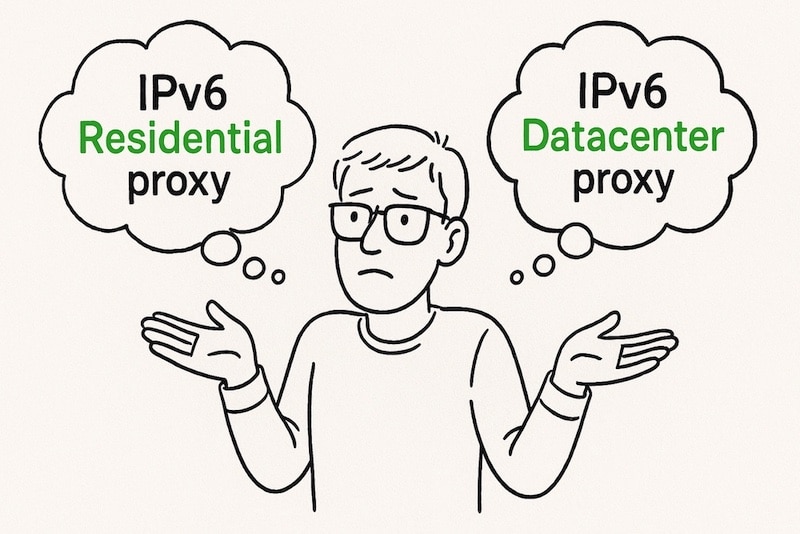
Table of Contents
- Why IPv6 Matters in 2026
- The state of residential IPv6 proxies
- The state of datacenter IPv6 proxies
- Head-to-head: residential IPv6 vs. datacenter IPv6 for scraping
- Decision framework: Which IPv6 proxy type should you pick?
- Implementation blueprint (dual-stack, target-aware)
- FAQs: residential vs. datacenter IPv6 proxies
- The final verdict
⚠️ Content Disclaimer. This article is for educational purposes only and is intended to explain IPv6 adoption trends and proxy types. It does not promote or endorse unlawful scraping, evasion of platform protections, or misuse of proxies. Readers are responsible for ensuring their activities comply with applicable laws, platform terms of service, and ethical guidelines, and should use proxies or automation only within lawful and transparent business practices.
1. Why IPv6 Matters in 2026
IPv6 isn’t fringe anymore. As of August 2026, almost half of all traffic to Google comes over IPv6. That’s close enough to say: if you’re scraping at scale—or working in regions where IPv6 adoption is strong—you can’t afford to ignore it.
So, what makes IPv6 proxies worth your attention?
Two things stand out:
- Massive address space. With 3.4×10^38 possible addresses, you can spin up huge proxy pools at a fraction of the cost of scarce IPv4.
- Adoption momentum. In markets like Asia-Pacific, more than half of users now access the web over IPv6. For those regions, native IPv6 support is basically table stakes. Source: APNIC, 2025
That said, IPv6 support isn’t universal. Only about a quarter of websites actually serve IPv6 today. In practice, this means if you run an IPv6-only proxy, you’ll still run into plenty of dead ends.
The smarter approach is to detect where IPv6 is supported and fall back to IPv4 when it’s not.
| 🔄 Quick refresher: IPv4 vs. IPv6 for proxies. IPv4 proxies use the legacy 32-bit address space (~4.3B addresses). They enjoy universal website compatibility and highly mature geolocation data—still essential for many targets. IPv6 proxies use the 128-bit space (virtually unlimited addresses). This eliminates NAT overhead and enables massive rotation. But they only reach IPv6-enabled websites, and some anti-abuse tools now block by subnet (/64) instead of single IPs. Learn more about the protocol differences in IPv6 vs IPv4 |
2. The State of Residential IPv6 Proxies
Even though most home internet users now get IPv6 from their ISPs, proxy providers rarely pass it through.
The big residential networks are still delivering about 75–100% of traffic over IPv4. IPv6 (when it appears) barely cracks a small percentage, 10-20%. In many cases, providers would filter it out entirely.
So why’s IPv6 still so scarce?
- Coverage gap. Many of the sites you’d want to scrape don’t fully support IPv6 yet. Providers stick with IPv4 because it works everywhere.
- Operational complexity. Keeping connections stable across thousands of home devices is already tricky. Add IPv6 into the mix, and it’s even harder. So most providers avoid the risk.
So, when does residential IPv6 actually shine?
That being said, there are a few places where residential IPv6 helps—if you can get it.
- High-Adoption Regions: In regions with high IPv6 adoption, like parts of the Asia-Pacific, native IPv6 traffic looks more like a real home connection.
- Account Fingerprinting: For account-related tasks, where “home user” fingerprints matter, IPv6 can blend in perfectly. (Just make sure the target domain actually supports it first.)
| 🔑 Bottom line: In 2026, residential IPv6 is promising but still a niche. For most workflows, you’ll need to lean on IPv4. The practical strategy is dual-stack—use IPv6 where it’s supported and fall back to IPv4 everywhere else. |
3. The State of Datacenter IPv6 Proxies
When it comes to availability and cost, datacenter IPv6 is really hard to beat. First, traditional cloud platforms hand out IPv6 addresses by default, which makes them abundant and often several times cheaper than IPv4. Some providers even sell full /64 subnets. This gives you massive pools for rotation at a fraction of the price.
Of course, scale comes with trade-offs.
Here’s what you need to watch out for:
- Range-level blocks. With IPv6, one bad request doesn’t just burn an address—it can poison the entire /64 range. If that happens, you risk losing hundreds of usable IPs in one shot. The fix: rotate by subnet groups, not just single IPs.
- Geolocation quirks. IPv6 geoIP databases aren’t always as sharp as their IPv4 counterparts. If your use case depends on city-level accuracy (i.e., for ads or local search), you’ll want to double-check the resolved location before you commit to large runs.
- Suspicion patterns. Bursts of rapid IPv6 rotations can quickly stand out and raise alarms. This is mainly because the traffic profile looks less common. The safer move is to throttle. Also, to mix in IPv4 and reuse sessions in realistic windows. Learn more about IP rotations.
| 🔑 Bottom line: If you’re chasing scale and lower costs, datacenter IPv6 is your strongest lever. Just build with subnet-level awareness and rotate conservatively. And with these precautions in mind, you’ll avoid the most common pitfalls. |
Cut Costs, Scale Smarter 💸
IPv6 DC proxies slash expenses compared to scarce IPv4—unlock massive savings without sacrificing performance.
Explore Cost-Efficient IPv64. Head-to-head: Residential IPv6 vs. Datacenter IPv6 for scraping
Residential and datacenter IPv6 proxies serve very different needs. One leans on ‘credibility’, the other on ‘scale’. If you’re weighing the trade-offs, such as availability, cost, block risks, and where each performs best… here’s the side-by-side view.
| Factor | Residential IPv6 | Datacenter IPv6 |
| Availability in 2026 | Limited; major providers rarely expose IPv6 pools | Abundant; easy to buy /64s and large IP pools |
| Cost / Pricing | Typically higher (if you can find it) | Low; often several times cheaper than IPv4 DC proxies |
| Trust/Reputation | Stronger “human” signal (home ISP) | “Server” signal; more scrutiny on some sites |
| IPv6 Coverage Reality | Useful only on IPv6-enabled targets | Same limitation—needs AAAA on target |
| Block behavior | Risk of network-wide reputation issues if abused | Range (/64) bans are common if you over-rotate |
| Geo accuracy | Strong country/city fidelity (ISP home lines) | Country-level reliable; city-level may be rough |
| Best fit | Account actions, user-like sessions on dual-stack sites | High-scale scraping on IPv6-ready domains |
Note: Availability/pricing and /64 risk summarized from industry testing and guidance.
🔑 Bottom line: Residential IPv6 looks more “human,” but it’s scarce and often pricier. Datacenter IPv6, on the other hand, is cheap and plentiful, but you have to manage subnet bans carefully. For most large-scale scraping today, I would recommend datacenter IPv6, which is a real workhorse. Residential IPv6, on the other hand, remains a niche tool for account-level or user-like tasks.
Learn more about bans in: IPv6 proxies: the answer to IPv6 bans.
5. Decision framework: Which IPv6 proxy type should you pick?
So, residential or datacenter IPv6 proxies? How do you know which one is better for your particular use case?
Choosing the right proxy type doesn’t have to be complicated.
You can think of it as a quick decision tree: Check if the site supports IPv6 > Decide if you need scale or authenticity > then layer in region > blocking > and geo requirements.
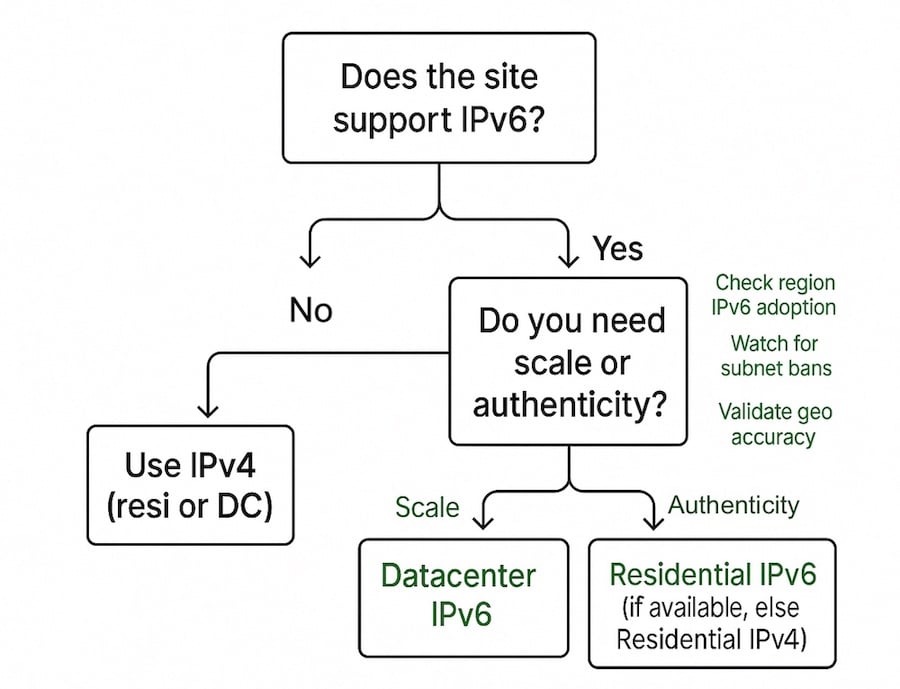
Here’s the breakdown.
1. Target support
- Run a DNS AAAA check. Try DNSChecker.org AAAA Lookup
- If no AAAA → use IPv4 (resi or DC).
- If AAAA exists → IPv6 is viable, but assume dual-stack since most sites still don’t support it.
2. Scale vs. authenticity
- Need massive concurrency, big pools, and low cost → Datacenter IPv6.
- Need home-ISP fingerprints for user-like sessions → Residential IPv6 (if you can find it). Otherwise, stick with Residential IPv4.
3. Region & audience
- High IPv6 adoption regions (e.g., APAC 50%+) → IPv6 paths improve reach. Learn more in: IPv6 Proxies at 50%: What Businesses Must Do Next
4. Blocking behavior
- If the target bans by subnet → slow rotations, keep sessions longer, and spread across multiple /64s (or mix IPv4).
5. Geolocation needs
- IPv6 can be imprecise at the city level. Validate before big runs.
- If you need exact locations → rely on IPv4 for accuracy.
| 🔑 Bottom line: Datacenter IPv6 is the lever for scale and cost savings. Residential IPv6 provides authenticity (but is rare). As mentioned before, for most workflows, dual-stack keeps you resilient. |
6. Implementation blueprint (dual-stack, target-aware)
A dual-stack (IPv6 and IPv4), target-aware setup is all about stability and cost control. Build with both IPv4 and IPv6 in play, and you’ll avoid surprises down the road. Learn more about: IPv4 to IPv6: Effective Transition Techniques
1. Map your targets
Keep a registry of domains you scrape. Run nightly DNS checks to see which ones support IPv6. Flag dual-stack sites as IPv6-ready, and mark IPv4-only sites so they route correctly.
2. Route by protocol
At request time, send traffic through IPv6 proxies if the site supports it. If not, fall back to IPv4 automatically. Save the state per domain so you’re not wasting time re-testing.
3. Rotate smartly on IPv6
Don’t just rotate by IP—rotate by subnet groups (/64s). Cool down each subnet before reusing it to avoid bans. For logins or accounts, pin sessions; for open pages, rotate more freely.
4. Validate your geo
Check IPv6 geoIP accuracy against IPv4 baselines. If a pool resolves to the wrong city or ASN, swap it out before you launch major campaigns.
5. Compare providers
Pricing and terms vary. Look at cost per subnet, rotation rules, and support for protocols like SOCKS5 or HTTP. Favor vendors that replace tainted /64s without hassle.
6. Stay compliant
Keep a file of terms of service, robots.txt rules, and API limits for your targets. Always log your legal basis for data collection. Compliance isn’t optional—it’s part of resilience.
| 📊 So, what can you expect if implemented? In 2026, a smart IPv6 setup means better coverage on dual-stack platforms like large CDNs. But it also means relying on IPv4 fallback for the majority of sites, since only about 27% serve IPv6 today. You can also expect lower cost per request at scale with datacenter IPv6, thanks to cheaper addresses and larger pools. But this is always true, as long as you rotate carefully to avoid /64 bans. Performance is usually on par with IPv4, and in some regions, latency even improves because traffic skips NAT. |
7. FAQs: Residential vs. Datacenter IPv6 Proxies.
Because you’re running IPv6-only. Most sites still don’t support it, so you need dual-stack with an automated IPv4 fallback.
Not yet. Keep an IPv4 core for universal reach. Use IPv6 DC proxies to offload IPv6-capable targets and lower your pricing per request.
A few niche options exist, but major residential networks rarely expose IPv6 today; most traffic remains IPv4. Vet carefully; require trial access and success-rate telemetry.
Mobile carriers were early IPv6 adopters, so traffic from them often looks very authentic for mobile-heavy targets. But here is the catch: If a site only supports IPv4, carriers translate requests behind the scenes, so you still need dual-stack support. And because IPv6 often assigns unique device addresses, blocks can hit faster than with IPv4 mobile. So you’ll want to rotate gently and test by carrier and region.
Neither protocol is inherently more private. Success depends on behavior (rates, headers, sessions), IP quality, and provider reputation—more than the version number.
User adoption is high, but server adoption still lags. Only about 27% of all websites serve IPv6 today. Among top domains, Cloudflare measured closer to 60%—but that’s skewed by a few giants. Translation: support is uneven, especially in the long tail.
8. The Final Verdict
If you want scale and lower costs, datacenter IPv6 is the clear winner in 2026 (provided you rotate by subnet and manage bans carefully).
Residential IPv6 can look more authentic, but it’s scarce and not reliable enough to build around.
The practical move is dual-stack: use IPv6 where it’s supported, fall back to IPv4 everywhere else, and you’ll balance reach, cost, and stability.
Scale Without Limits 🚀
Datacenter IPv6 proxies offer huge pools at low cost—perfect for high-volume scraping.
Try Datacenter IPv6
0Comments