 By
By
IPv6 adoption has finally crossed the 50% threshold. This has changed how businesses should approach proxy strategies. This article explains why a dual-stack approach is now critical. It also outlines the risks of ignoring IPv6 and shows how organizations can capitalize on its cost efficiency and scalability. You will also learn how IPv6 impacts residential, datacenter, and mobile proxies and what compatibility gaps remain. And finally, you will learn which integration strategies will future-proof your operations.
Table of Contents
- The IPv6 Adoption Landscape
- Regional Adoption Variations
- How IPv6 Changes Business Proxy Strategies
- IPv6 Across Different Proxy Types
- Website Compatibility: The Reality Check
- Strategic Implementation Guide
- FAQ
- Final Words
1. The IPv6 Adoption Landscape
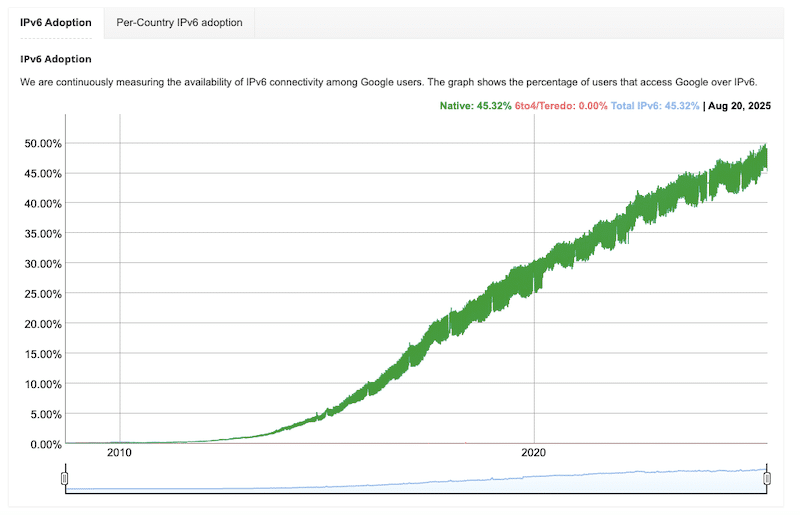
IPv6 adoption has reached a critical milestone: roughly half of global Internet traffic now uses IPv6.
As of early 2026, 43%–45% of users reach Google services via IPv6. This trend is expected to cross the 50% mark in 2026 for the first time. So, what we can see from this is that IPv6 is no longer just a niche protocol—it’s becoming the default path for Internet communication.
What does this mean for businesses? This 50% global adoption means ignoring IPv6 is no longer an option. Businesses managing proxy networks for web scraping, automation, email, social media or data collection must ensure their systems are 100% IPv6-capable. Failing to support IPv6 could mean losing reach to a substantial user base or missing data from IPv6-dependent networks.
Key Global Metrics:
Major content providers like Google, Facebook, and YouTube have enabled IPv6 for some time now. They know being IPv6-ready is the recipe for growth. In addition, the exhaustion of IPv4 addresses is making ISPs and mobile carriers to deploy IPv6. So, the IPv6 usage is growing ~4–5% per year, with the 50/50 IPv6-to-IPv4 traffic crossover occurring in late 2024/early 2025 (en.wikipedia.org).
If you are curious to know the current statistics on worldwide users accessing Google via IPv6 check Google’s IPv6 Adoption.
Why This Matters for Proxy Users:
If your business relies on proxies, know this: 50% adoption means IPv6 has crossed from “nice to have” to “business necessity.” Any organization depending on full internet connectivity for use cases like web scraping, email deliverability, market research, or automation—must ensure their systems handle both protocols (IPv6 and IPv4). Learn more about IPv6 Effective Transition Mechanisms.
The dual-stack reality: IPv4 still carries half of traffic. But IPv6 now matches it and continues to grow. So, your business needs to be ready to operate in this dual-protocol environment for the foreseeable future.
2. Regional Adoption Variations
IPv6 deployment is uneven across different regions and countries.

You can have an idea of the regional adoption using the below map. This shows the percentage of people visiting Google via IPv6. Learn more from Google’s IPv6 adoption per country.
According to Google and APNIC statistics (blog.apnic.net):
- North America (ARIN region): ~52% IPv6 adoption
- Asia-Pacific (APNIC region): ~50% adoption
- Latin America (LACNIC): ~39% adoption
- Europe/Middle East (RIPE): ~28% adoption average
- Africa (AFRINIC): ~4% adoption
Leading countries: Over 21 countries have crossed the 50% IPv6 deployment mark (pulse.internetsociety.org):
- France and India: ~73–80% of traffic over IPv6
- Germany: ~75%
- United States: ~53%
- New entrants: Brazil, Mexico, Japan, Hungary, Sri Lanka, Guatemala, and Saudi Arabia recently surpassed 50% (tech.slashdot.org)
Lagging countries: China has under 5% adoption despite having the world’s largest internet user base (en.wikipedia.org). Google stats show about 19% on China.
Why IPv6 Is Already the Norm in Some Markets (and Not Others)
If your business is focused on Europe or India, you can’t afford to ignore IPv6. In these regions, the protocol has become so common that any serious service is expected to support it natively. On the other hand, if your operations lean toward China or Africa, IPv4 is still the dominant standard. That said, governments in both areas are pushing new initiatives, and the balance could shift quickly.
Things look different in mobile-first markets. Here, carriers often roll out IPv6 by default, which means adoption is higher than average. For anyone simulating authentic mobile users, relying on IPv6 proxies is critical.
🌍 Go Dual-Stack Now
Future-proof your reach with IPv6 proxies while keeping IPv4 fallback intact.
Try IPv6 Proxies3. How IPv6 Changes Business Proxy Strategies
a. Address Abundance vs. Scarcity
The reality with IPv4 is simple: there are only 4.3 billion addresses available worldwide. That hard limit creates scarcity. And scarcity drives up costs. As a result, proxies are becoming expensive, and providers are often forced to reuse the same IPs across multiple clients.
IPv6 changes the game entirely. Instead of billions, it offers 340 undecillion addresses—an amount so vast it’s essentially limitless. With that kind of supply, providers can create enormous pools of proxy endpoints at a fraction of the cost. In some cases, you can get millions of IPv6 addresses for what you’d normally pay for just a handful of IPv4 ones.
b. Cost Structure Revolution
As said previously IPv6 proxies usually come at a much lower price than their IPv4 counterparts. In some cases, providers charge only a fraction of the cost. Because the supply of addresses is so abundant, businesses can stretch their budgets much further.
Instead of being limited by price or availability, these proxy providers can build larger proxy pools and rotate IPs more aggressively. Plus, they can also scale their operations without running into address shortages.
c. Future-Proofing Requirements
Countries across Asia—especially India, Malaysia, and Vietnam—aren’t just experimenting with IPv6; they’re mandating it. India, for instance, requires all public-sector websites to support IPv6, and new internet connections for consumers must already be IPv6-capable. Vietnam has taken a staged approach. By 2022, about half of its government websites had moved to IPv6. By 2025, the Vietnamese government expected every site to make the switch. TWNIC IPv6 Forum (2025) – Vietnam’s multi-stage IPv6 rollout (PDF).
So, compliance isn’t longer optional. If your systems need to interact with government platforms or telecom networks in these regions, IPv6 support is now the minimum standard.
d. User Experience Considerations
Mobile networks tell a different but equally important story. Many carriers now operate with an IPv6-first approach, and some have already rolled out IPv6-only networks. apalrd.net – Networking blog with IPv6-first carrier.
In these setups, IPv4 isn’t gone but instead handled through translation layers like NAT64 or DNS64. That shift makes IPv4 an add-on an not the default. For businesses, this means user experience testing has to account for IPv6 pathways. If you ignored these, you could miss real issues that only appear for IPv6 users—things like added latency, compatibility glitches, or odd behaviors from translation. To catch those problems before you reach your customers, IPv6 scenarios must be part of every serious testing plan.
4. IPv6 Across Different Proxy Types
| Proxy Type | Adoption | Key Advantage | Main Challenge | Takeaway |
| Residential | Slow (mostly IPv4) | Broad compatibility | Limited ISP/site IPv6 support | Keep IPv4 fallback |
| Datacenter | Ready & cheap | Massive /64 subnets | Entire ranges get blocked | Great for scale, manage carefully |
| Mobile | IPv6 native | Looks like real mobile traffic | No shared IP shield | Best for stealth |
a. Residential Proxies: Slow Adoption
Most residential proxy providers still operate almost exclusively on IPv4. With over 99% of major networks using IPv4 by default.
Why the Hesitation?
- Many target websites lack IPv6 support
- Providers have extensive IPv4 infrastructure
- Smaller ISPs don’t offer reliable IPv6 services
- Stability and monitoring challenges with IPv6 residential connections
Business Takeaway: Ask your residential proxy provider about their IPv6 roadmap, but don’t count on widespread availability just yet. Plan for IPv6 but maintain IPv4 fallbacks.
b. Datacenter Proxies: Ready and Abundant
Nearly all cloud platforms provide native IPv6 connectivity. This advantage makes IPv6 address blocks trivial and often free to obtain. So, there is an opportunity here: Providers offer large IPv6 subnets (/64 or larger) at very low costs, enabling massive IP rotation for web scraping operations.
- The Caveat: Websites often block entire IPv6 ranges when detecting abuse, not just individual IPs. A single misstep can burn thousands of proxy IPs in one stroke.
- Strategic Use: Perfect for large-scale operations needing massive IP diversity. But, of course, it requires careful subnet management and distribution strategies.
c. Mobile Proxies: IPv6 Native
Many mobile carriers have moved to IPv6-only networks with IPv4 accessed through NAT64 translation. T-Mobile US, for example, assigns only IPv6 addresses publicly.
- The Advantage: Mobile IPv6 traffic appears as authentic phone traffic, often flying under anti-bot radar systems.
- But here is what you need to consider: Each device often gets unique IPv6 addresses, potentially reducing the traditional “IP reputation shield” effect where many users share IPv4 addresses.
5. Website Compatibility: The Reality Check
The internet today sits in an awkward middle ground. Around half of users already connect with IPv6, yet only about 40 percent of the top 1,000 websites support it. That gap creates friction. This is especially true since major players—Amazon, Twitter (X), GitHub, and WordPress.com—still hold back on full adoption. Because of this, businesses can’t rely on a single protocol to cover every audience or site.
To stay reliable, companies need both protocols. IPv6 proxies handle dual-stack sites well. They often come with faster speeds and wider IP diversity. But IPv4 proxies still remain essential. This is because a large portion of the web hasn’t switched. The most efficient setup uses protocol-aware routing, which automatically picks the right proxy for each target and keeps coverage seamless. IPv6 also, must of the time delivers faster speeds thanks to more direct routing, without extra translation layers. Its massive address space also supports huge rotation pools; perfect for avoiding reuse patterns and spreading out traffic.
Still, IPv6 brings challenges.
Some anti-bot systems flag IPv6 traffic as unusual. But this ‘problem’ should fade as adoption grows. Geolocation data can also be less precise at the city level, and wide subnet blocks may expose large address ranges to restrictions. Together, these factors show that IPv6 offers real advantages, but also new limitations that businesses must be aware of.
6. Strategic Implementation Guide
We’ve covered why IPv6 matters and its adoption but the real challenge is putting it into practice. To make this shift manageable, here’s a step-by-step roadmap:
a. Phase 1: Assessment and Planning
- Audit Your Targets: Check which sites/APIs you access have IPv6 support (AAAA DNS records)
- Evaluate Your Infrastructure: Ensure your servers/tools can handle IPv6 addresses
- Research Regional Needs: Understand IPv6 adoption in your target markets
b. Phase 2: Dual-Stack Infrastructure
- Network Connectivity: Verify IPv6 routing on your systems
- Software Compatibility: Test proxy management tools with IPv6 addresses
- DNS Configuration: Enable AAAA record handling
c. Phase 3: Smart Proxy Integration
- Protocol-Aware Routing: Use IPv6 for compatible targets, IPv4 for others
- Intelligent Rotation: Spread traffic across multiple IPv6 subnets
- Monitoring and Fallback: Log failures and implement automatic IPv4 fallback
d. Phase 4: Optimization and Scaling
- Leverage Cost Advantages: Allocate IPv6-friendly tasks to cheaper IPv6 proxies
- Geographic Targeting: Use IPv6 in high-adoption regions for authentic simulation
- Performance Tuning: Monitor and optimize for IPv6-specific benefits
Learn more about IPv6 transition steps.
7. FAQ: IPv6 Proxies Adoption
No. With 60% of top websites still IPv4-only, you need a dual-stack approach. Use IPv6 where it provides advantages (cost, scale, authenticity) but maintain IPv4 for full coverage.
Generally, no. IPv6 proxies are often significantly cheaper due to abundant address availability. Some providers offer IPv6 pools at a fraction of IPv4 pricing.
Most modern tools support IPv6, but verify compatibility. Look for proper IPv6 address parsing (brackets notation) and dual-stack DNS resolution.
Now. With 50% global adoption, IPv6 is mainstream enough that ignoring it risks missing significant user segments and opportunities.
Use DNS lookup tools to check for AAAA records, or try accessing the site with an IPv6-only connection. Many online tools can test IPv6 website compatibility.
8. Final Words.
IPv6 now accounts for nearly half of global traffic!
This underestimated stat marks a major shift in global internet infrastructure. If your business uses proxies, this knowledge can bring both advantages and hurdles.
IPv6 offers virtually unlimited addresses, lower costs, better performance, and stronger scalability. If you are an early adopter, you’ll gain a clear edge by aligning with the internet’s future. Yet, challenges remain: many sites still rely on IPv4. Plus, IPv6 adoption still varies by region, making compatibility a real concern.
The answer is balance.
- A dual-stack strategy uses IPv6 where possible while keeping IPv4 for universal coverage.
- As adoption climbs past 60% and beyond, those prepared with both protocols will transition the smoothest.
- The real question is no longer if—but how fast—you can adapt.
💸 Cut Proxy Costs
Save money with scalable IPv6 proxies that cost a fraction of IPv4.
Get IPv6 Access
0Comments