 By
By
Are your review pipelines breaking? Are you missing sentiment data? Teams that analyze e-commerce performance depend on clean, uninterrupted review scraping. Read on to learn how product analysts and retail intelligence teams collect public Amazon reviews without getting banned, dealing with noise, or experiencing gaps.
Table of Contents
- Amazon Reviews Drive Product Intelligence – If You Can Collect Them Reliably
- Why Amazon Defends Its Reviews So Aggressively
- How to Scrape Amazon Reviews Safely, Consistently, and at Scale
- What Reliable Amazon Review Scraping Means for Your Business
- Why Teams Choose RapidSeedbox for Amazon Review Scraping
- Ready to Scrape Amazon Reviews Without the Headaches?
- FAQs
Amazon Reviews Drive Product Intelligence – If You Can Collect Them Reliably
If you work in e-commerce analytics, pricing intelligence, or product research, Amazon reviews are essential. They’re the fuel for:
- Sentiment analysis (positive/negative trends)
- Feature request mining
- Competitor benchmarking
- Product quality detection
- VOC (Voice of Customer) insights
- Warranty/return risk modeling
- Market opportunity forecasting
But scraping Amazon reviews comes with multiple challenges:
- Frequent Captchas
- IP bans after a few pages
- Incomplete review cards
- Missing star ratings or timestamps
- Region mismatch (different marketplaces)
- HTML structure variation by locale
- Infinite scroll loads that break static scrapers
An unstable review pipeline affects everything downstream, including sentiment accuracy, competitor models, pricing decisions, and product launches.
Why Amazon Defends Its Reviews So Aggressively
Amazon uses one of the most complex anti-bot systems in ecommerce.
It actively observes:
- IP reputation and network identity
- Review pagination behavior
- TLS fingerprinting
- Header consistency
- Scroll timing
- Repeated identical product lookups
- Geo-region mismatches
- Headless browser signals
- Cookie freshness
Platforms rarely say “blocked.” Instead, they break your data:
- Missing review bodies
- Out-of-order review sequences
- Empty next-page buttons
- Captchas appearing mid-scroll
- Silent throttling
- Repeated review batches appearing as “new”
For product analysts, this results in distorted sentiment and false insights about competitors – the worst kind of data error.
How to Scrape Amazon Reviews Safely, Consistently, and at Scale
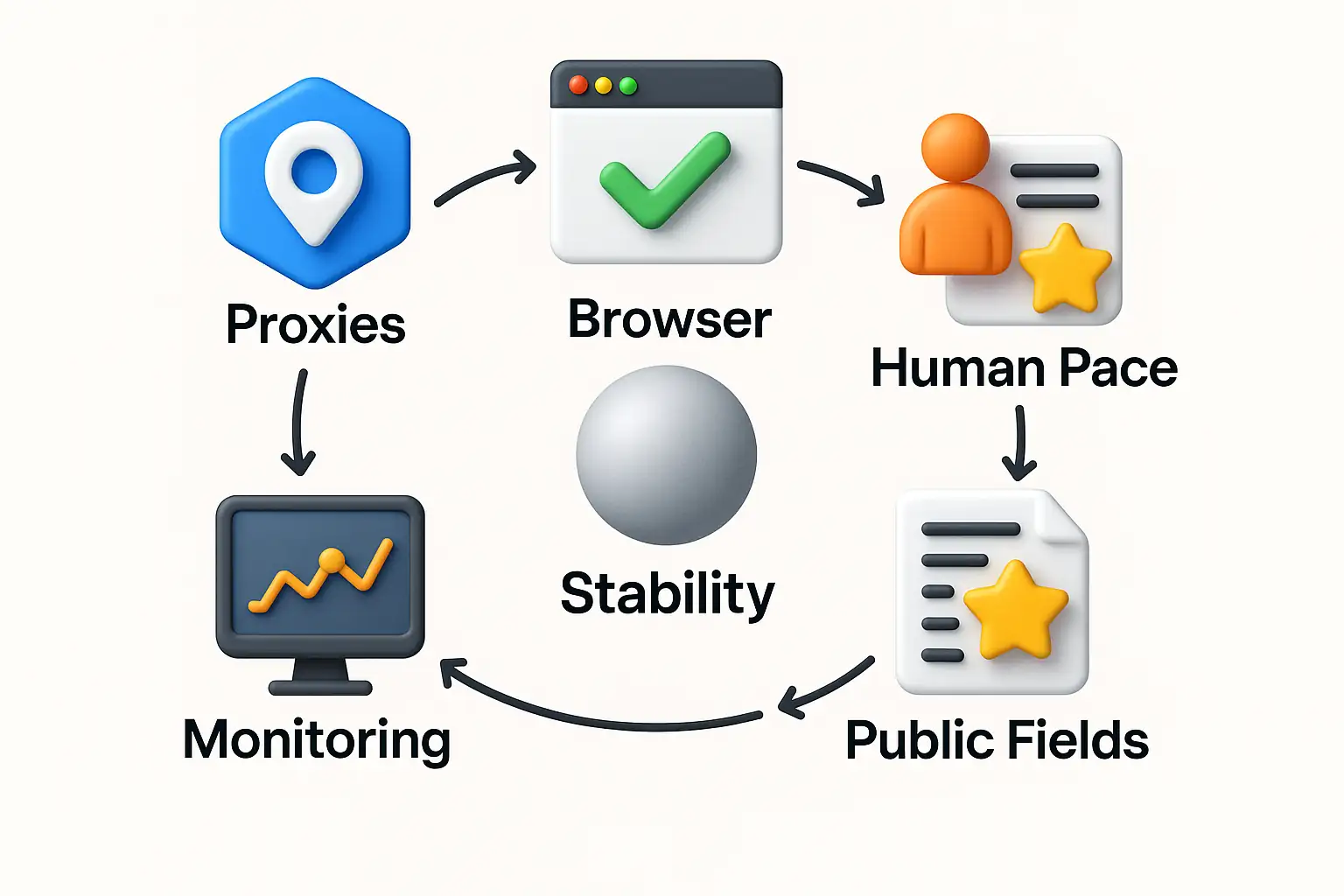
To safely scrape Amazon reviews, use geo-aligned residential proxies and Playwright or Puppeteer for full dynamic rendering and human-paced scrolling. Only collect publicly visible review fields, and monitor block signals, such as missing timestamps or repeated pages, to maintain long-term stability.
1. Use Residential Proxies with Region Alignment (US, UK, DE, etc.)
Amazon reviews vary significantly between marketplaces.
Your IP determines:
- Which reviews you see
- The language of the reviews
- Filter defaults (e.g., verified purchase)
- Review sorting behavior
- Availability of photos and videos
- Vine/early reviewer program visibility
Residential proxies solve the biggest problem:
Amazon instantly flags datacenter IP ranges.
Residential rotation helps with:
- Lower block rate
- Consistent pagination
- Region-accurate review sets
- Reduced Captchas
- Cleaner sentiment pipelines
If you analyze multiple markets, you need multiple region pools (US, UK, DE, FR, CA, JP).
With support for over 195 regions, RapidSeedbox is ideal for multi-locale product intelligence.
2. Use Real Browser Automation – Amazon Loads Reviews Dynamically
Amazon’s review sections use dynamic JavaScript (JS), infinite scrolling, and lazy-loaded elements.
A static HTML request will miss:
- Review body
- Star rating
- Username
- Images/videos
- “Verified purchase” flags
- Review helpfulness count
- Pagination clusters
Playwright or Puppeteer ensure full render:
|
1 2 3 4 5 6 7 8 9 10 11 |
from playwright.sync_api import sync_playwright with sync_playwright() as p: browser = p.chromium.launch(headless=False) page = browser.new_page() page.goto("https://www.amazon.com/product-reviews/B08N5WRWNW/") page.wait_for_timeout(3000) page.evaluate("window.scrollBy(0, document.body.scrollHeight)") html = page.content() browser.close() |
This captures all visible review data, not partial fragments or placeholders.
3. Emulate Real User Behavior – Amazon Tracks Movement Patterns
Review sections are interactive, and that’s why Amazon expects:
- Gradual scroll
- Irregular timing
- Occasional pauses (“reading time”)
- Realistic click behavior on “next page”
- Random scroll-backs
- Variation in scroll depth and velocity
You can give our bot detection test a try to check if you’ll get flagged.
Safe pacing example:
- Scroll, then pause for 1.5-4 seconds.
- Scroll and pause for 2-6 seconds.
- Next page: Wait 3-7 seconds.
- Every 4-7 pages: Take a 10-20 second break.
Avoid:
- Uniform auto-scrolling
- Zero-delay pagination
- Identical query loops
- Parallel scraping from the same IP
Using human pacing greatly reduces CAPTCHA storms.
4. Only Scrape Publicly Accessible Review Fields (For Compliance)
You can only extract the information that any user sees without logging in.
That includes public fields:
- Review body
- Star rating
- Reviewer display name
- Timestamp (date)
- Product variant (if shown)
- Country/market
- “Verified purchase” badge
- Helpful vote count
- Images/videos posted by reviewers
- Review title
Avoid:
- Private reviewer details
- Account-only panels
- Seller dashboards
- Internal metrics
- Restricted program data
Sticking to public channels protects your data workflow and ensures its long-term safety.
5. Monitor Review Completeness, Pagination Health, and Silent Blocks
Amazon soft-blocks more often than it hard-blocks.
Monitor for:
- Missing timestamps
- Repeated review page loops
- Falling review counts
- Empty photo grids
- Missing star ratings
- Unusually fast response times (pre-block stage)
- Captcha spikes
- Layout changes (Amazon modifies the DOM weekly)
Unless you detect it early, review pipelines rot slowly.
What Reliable Amazon Review Scraping Means for Your Business
Clean review data is one of the few ways to gain an understanding of real customer psychology on a large scale.
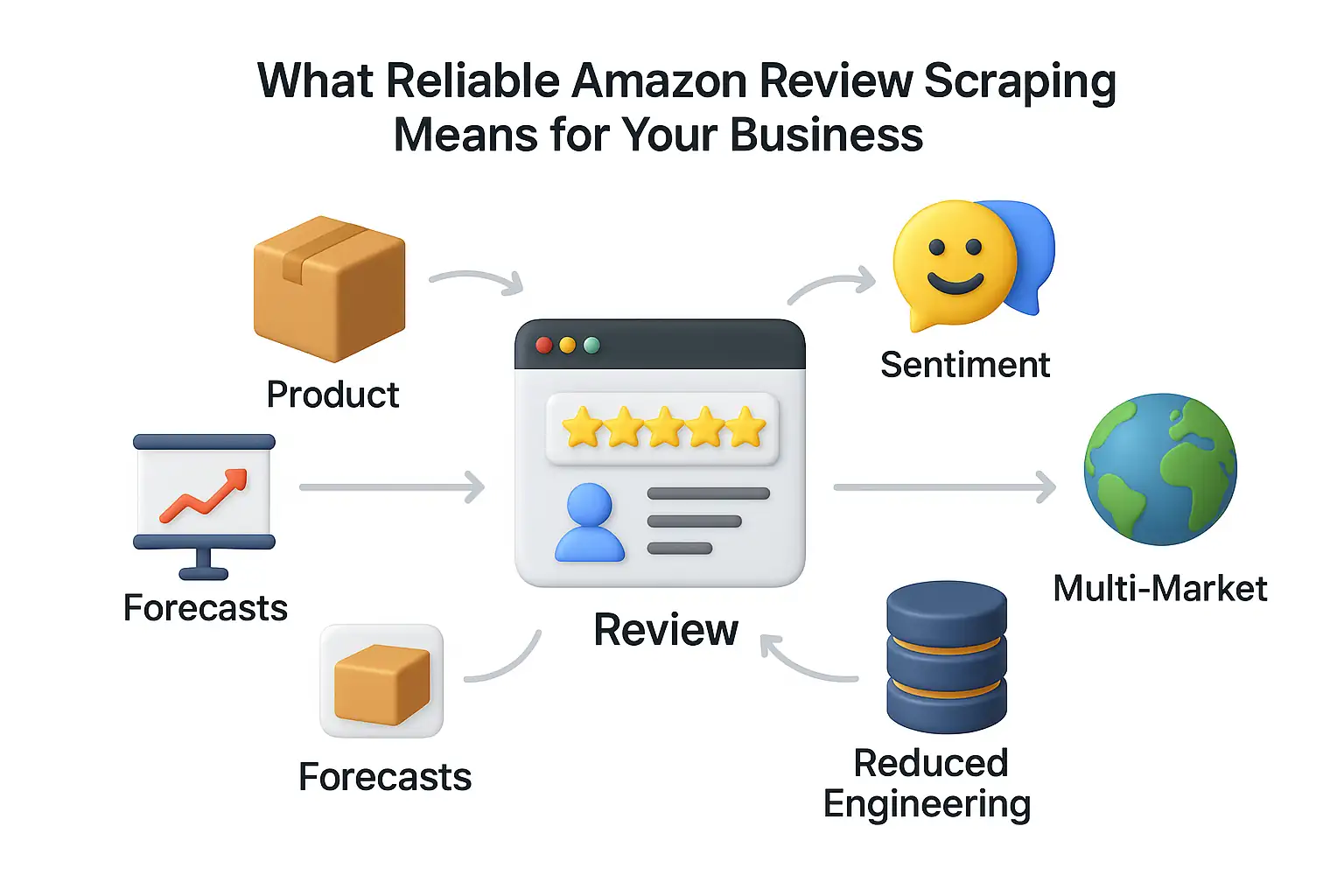
Stronger Sentiment Models
Accurate review text leads to better predictive modeling.
Better Product Decisions
Review patterns expose recurring quality issues before your competitors notice them.
Competitive Benchmarking
See what customers love about competitor products, and where they fail.
Multi-Market Analysis
Region-targeted proxies unlock cross-country sentiment comparisons.
Reduced Engineering Burden
Stable pipelines mean fewer “Why is the review feed empty?” emergencies.
Higher-Confidence Market Forecasts
Review velocity and rating changes are powerful leading indicators.
A clean review process improves the effectiveness of your entire ecommerce intelligence stack.
Why Teams Choose RapidSeedbox for Amazon Review Scraping
Large-scale scraping of Amazon reviews requires more than just a proxy list. Predictability, stability, and clean geo-alignment are also necessary.
RapidSeedbox provides:
- Clean residential proxy pools
- Region-accurate IP selection
- Low block and Captcha frequency
- Human engineering support
- Transparent dashboards
- A test-first onboarding flow
Ready to Scrape Amazon Reviews Without the Headaches?
If your product analysis, forecasting, or competitive insights depend on Amazon reviews, you need a stable infrastructure, not luck.
With RapidSeedbox, you get the quality rotation, geo accuracy, and human support you need for long-term review scraping.
FAQs
You may collect public review data, but you must follow all terms and applicable laws.
Amazon tailors reviews and filtering based on the marketplace (e.g., US, UK, DE). That’s why using proxies is important.
Residential rotating proxies with precise marketplace targeting.
Daily for most products; hourly for high-velocity categories.
Signs include missing timestamps, repeated pages, partial review cards, and sudden captchas.
Many teams collect both reviews and product details to strengthen their competitive analysis. If you also need pricing, inventory, or listing metadata, see our guide on how to scrape Amazon product data for a safe, scalable workflow.
Disclaimer: This content is for educational purposes only. RapidSeedbox does not encourage violating any website’s Terms of Service. Users are responsible for ensuring their scraping practices comply with applicable laws and policies.
0Comments