 By
By
When your online projects require blazing-fast internet speeds and rock-solid reliability, datacenter proxies deliver unmatched performance. That’s why, we’ll share how to buy datacenter proxies and everything you need to know about them. Whether you’re scraping websites, managing multiple accounts, or automating business processes, selecting the appropriate datacenter proxy is crucial for your success.
Table of Contents
- What Are Datacenter Proxies?
- Why Buy Datacenter Proxies?
- Datacenter vs Residential Proxies
- Key Features to Look for When Buying
- Best Use Cases for Datacenter Proxies
- How to Choose the Right Provider
- Pricing Models Explained
- Setup and Configuration Guide
- Common Mistakes to Avoid
- Frequently Asked Questions About Datacenter Proxies
- Final Words
Disclaimer: This material has been developed strictly for informational purposes. It does not constitute endorsement of any activities (including illegal activities), products or services. You are solely responsible for complying with the applicable laws, including intellectual property laws, when using our services or relying on any information herein.
1. What Are Datacenter Proxies?
Data center proxies are IP addresses hosted on servers in data centers, as opposed to being assigned to residential internet users. They act as intermediaries between your device and the internet, routing your requests through high-performance servers in professional hosting facilities.
Unlike residential proxies, which use IP addresses from real households, data center proxies are specifically generated for proxy services. This fundamental difference provides distinct advantages in terms of speed and reliability, though there are trade-offs in terms of detection resistance.
How Datacenter Proxies Work
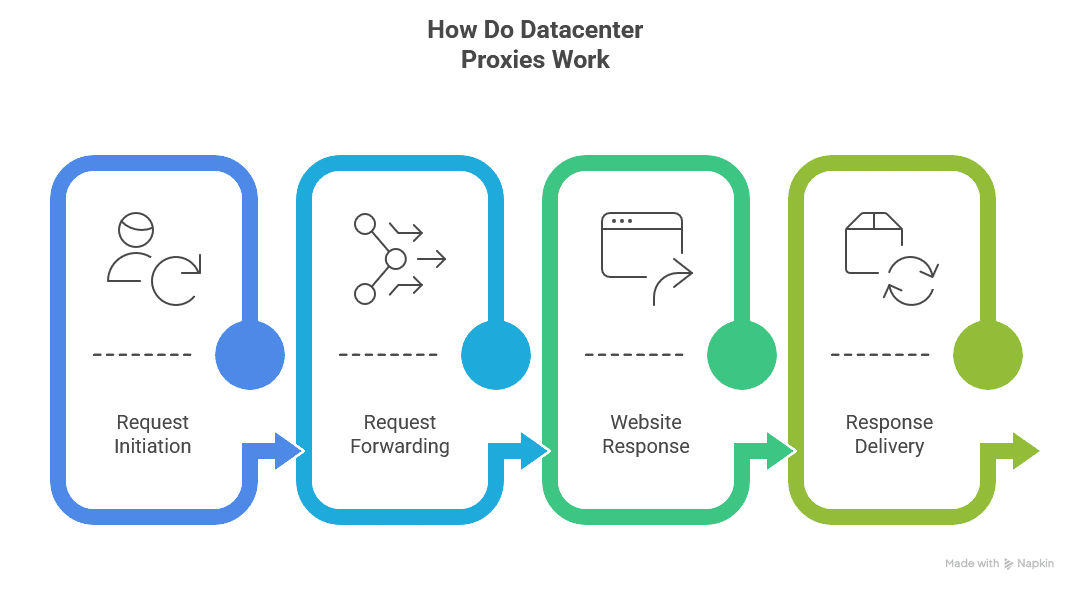
When you connect through a datacenter proxy:
- Your request goes to the proxy server in the data center
- The proxy server forwards your request to the target website using its IP address
- The website responds to the proxy server
- The proxy server sends the response back to you
This process happens in milliseconds thanks to the high-speed infrastructure of data centers, making datacenter proxies ideal for time-sensitive applications.
2. Why Buy Datacenter Proxies?
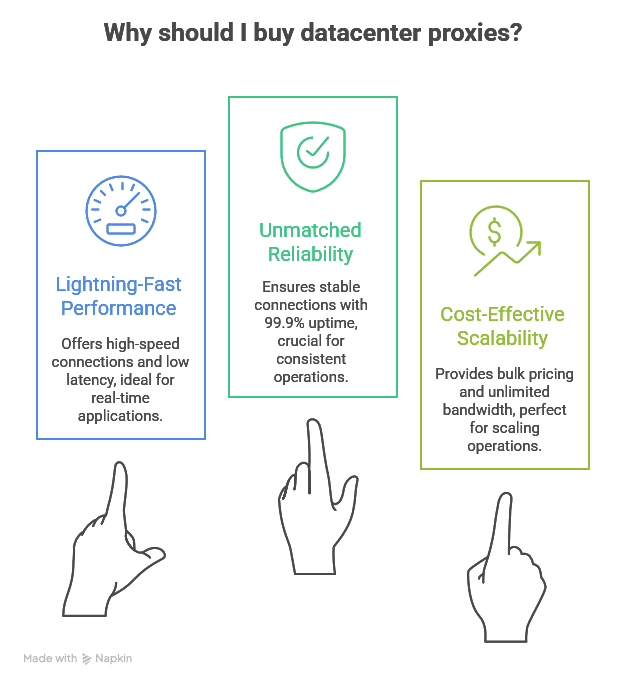
When it comes to buying data center proxies, three critical factors often come into play: speed, stability, and cost-effectiveness. Let’s explore why these proxies have become the preferred choice of many professionals and businesses.
a. Lightning-Fast Performance
Datacenter proxies consistently deliver the fastest connection speeds in the proxy market. With dedicated bandwidth and enterprise-grade infrastructure, you can expect:
- Download speeds often exceeding 100 Mbps
- Ultra-low latency for real-time applications
- Consistent performance even during peak usage times
b. Unmatched Reliability
Professional data centers offer 99.9% uptime guarantees, ensuring your proxy connections remain stable when you need them most. This reliability stems from:
- Redundant internet connections
- Backup power systems
- Professional monitoring and maintenance
c. Cost-Effective Scalability
When you need multiple IP addresses or high bandwidth usage, datacenter proxies offer the best value. Many providers offer:
- Bulk pricing for multiple IPs
- Unlimited bandwidth options
- Flexible subscription models
3. Datacenter vs Residential Proxies
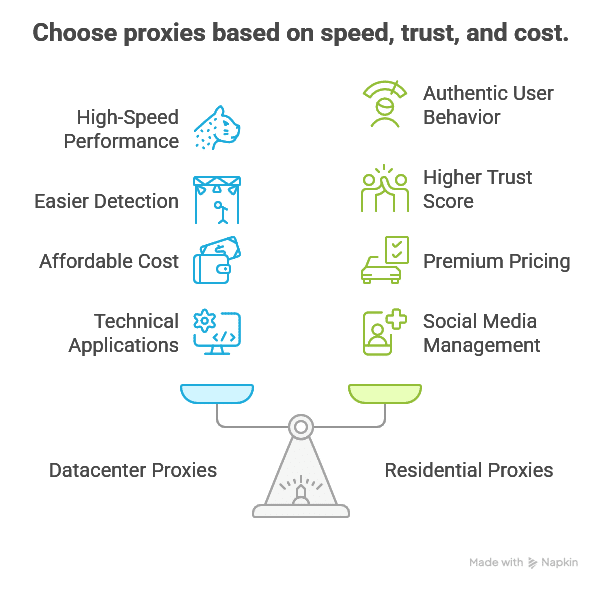
Understanding the key differences between datacenter and residential proxies helps you make an informed purchasing decision. Here’s a detailed comparison:
a. Speed and Performance
Datacenter Proxies:
- Speeds up to 1 Gbps available
- Consistent low latency
- Optimized for high-throughput applications
Residential Proxies:
- Speeds typically 10-50 Mbps
- Variable latency depending on user’s connection
- Better for applications requiring authentic user behavior
b. Detection and Trust
Datacenter Proxies:
- Easier to detect as non-residential
- May face restrictions on some platforms
- Perfect for technical applications and APIs
Residential Proxies:
- Harder to detect and block
- Higher trust score with websites
- Better for social media and e-commerce
c. Cost Considerations
Datacenter Proxies:
- More affordable per IP
- Often include unlimited bandwidth
- Better value for high-volume usage
Residential Proxies:
- Higher cost per GB of data
- Bandwidth-based pricing common
- Premium pricing for authentic IPs
d. Ideal Use Cases
Choose Datacenter Proxies for:
- Web scraping and data collection
- SEO monitoring and analysis
- API testing and development
- High-frequency trading applications
- Content delivery and caching
Choose Residential Proxies for:
- Social media management
- E-commerce price monitoring
- Ad verification and compliance
- Market research requiring authentic behavior
For more details, check out our comprehensive guides on proxy types and applications.
4. Key Features to Look for When Buying
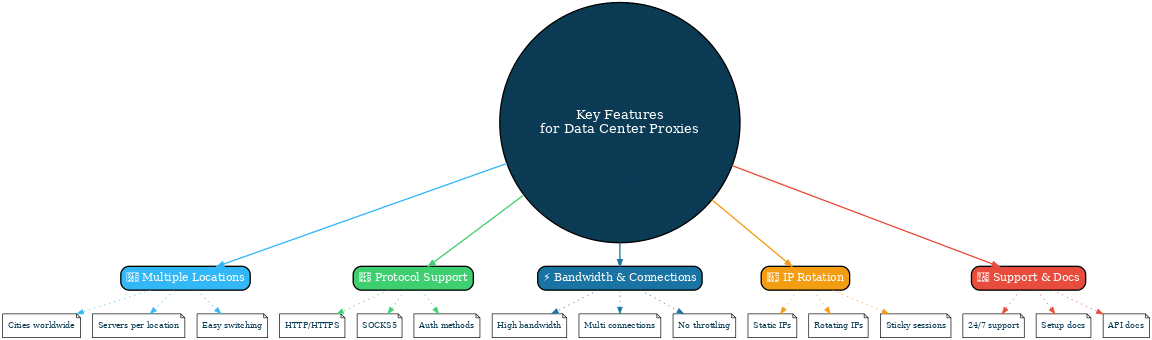
Not all data center proxy providers are created equal. When evaluating your options, prioritize the following essential features:
a. Multiple Geographic Locations
Global IP coverage allows you to access geo-restricted content and browse as if you were in different regions. Look for providers that offer this service.
- IPs from major cities worldwide
- Multiple servers per location
- Easy location switching capabilities
b. Protocol Support
Modern applications require flexible protocol support. Make sure your provider offers the following:
- HTTP/HTTPS proxies for web browsing and API calls
- SOCKS5 support for enhanced security and application compatibility
- Authentication methods including username/password and IP whitelist
c. Bandwidth and Concurrent Connections
Evaluate the provider’s capacity limits:
- Unlimited or high bandwidth allowances
- Support for multiple simultaneous connections
- No throttling during peak usage
d. IP Rotation Options
Depending on your use case, you might need:
- Static IPs for consistent identity
- Rotating IPs to avoid detection
- Sticky sessions for maintaining state across requests
e. Customer Support and Documentation
Quality support can save you hours of troubleshooting:
- 24/7 technical support availability
- Comprehensive setup documentation
- API documentation for developers
5. Best Use Cases for Datacenter Proxies
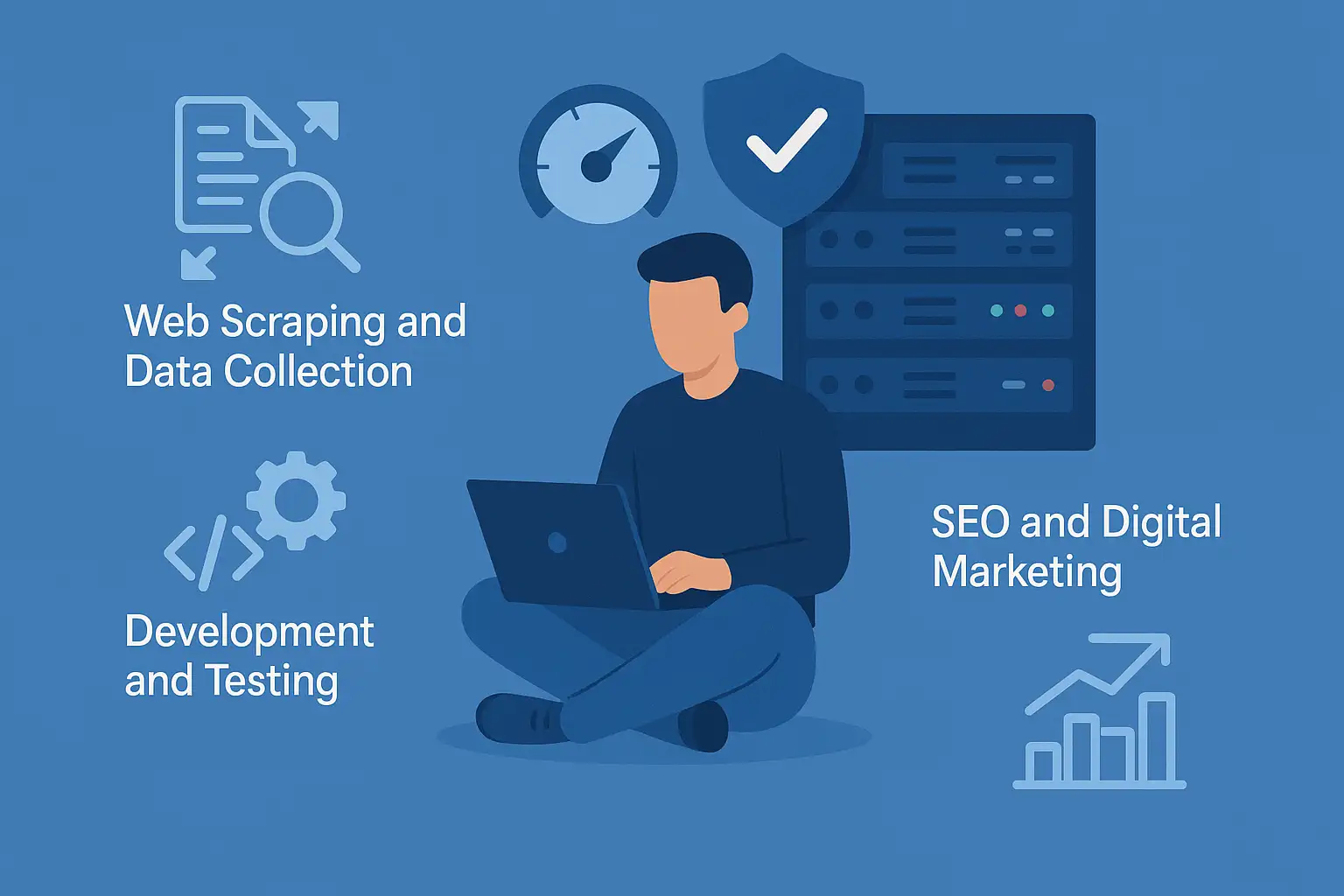
Data center proxies are ideal for scenarios where speed and reliability are more important than appearing as a typical residential user. The most effective applications are:
a. Web Scraping and Data Collection
When you need to extract large amounts of data quickly, datacenter proxies provide the performance edge:
- E-commerce monitoring: Track competitor prices and inventory levels
- News aggregation: Collect articles from multiple sources simultaneously
- Research data gathering: Extract academic or market research information
- Real estate listings: Monitor property prices and availability
b. SEO and Digital Marketing
Digital marketers rely on datacenter proxies for:
- Keyword rank tracking: Monitor search positions across different locations
- Competitor analysis: Analyze competitor websites and strategies without detection
- Social media monitoring: Track brand mentions and sentiment analysis
- Content performance testing: Test how content appears in different regions
c. Development and Testing
Software developers use datacenter proxies for:
- API testing: Test applications from different IP addresses
- Load testing: Simulate traffic from multiple sources
- Geo-restricted content testing: Verify app functionality across regions
- Security testing: Test systems against various IP-based attack patterns
d. Business Intelligence
Companies leverage datacenter proxies for:
- Market research: Gather competitive intelligence without revealing company identity
- Price intelligence: Monitor pricing across multiple markets and platforms
- Trend analysis: Collect data on industry trends and consumer behavior
- Due diligence: Research potential partners or acquisition targets
6. How to Choose the Right Provider
Selecting the ideal data center proxy provider requires careful evaluation of several factors. Here’s a systematic approach to making the best choice:
a. Assess Your Technical Requirements
Start by defining your specific needs:
Bandwidth Requirements:
- How much data will you transfer monthly?
- Do you need burst capacity for peak usage?
- Is unlimited bandwidth essential for your use case?
Geographic Coverage:
- Which countries or regions do you need to access?
- Do you require city-level targeting?
- How important is having multiple IPs per location?
Concurrent Connections:
- How many simultaneous connections do you need?
- Will you be running multiple applications?
- Do you need dedicated or shared resources?
b. Evaluate Provider Reputation
Research potential providers thoroughly:
- Check customer reviews on independent platforms
- Look for case studies and success stories
- Verify uptime guarantees and performance claims
- Assess the company’s track record and financial stability
c. Test Performance and Reliability
Most reputable providers offer trial periods or money-back guarantees. Use this opportunity to:
- Test connection speeds from your target locations
- Verify compatibility with your applications
- Assess customer support responsiveness
- Monitor uptime and connection stability
d. Compare Pricing Models
Understand exactly what you’re paying for:
- Per-IP pricing vs. bandwidth-based models
- Setup fees and contract commitments
- Overage charges and fair usage policies
- Discounts for longer-term commitments
Need reliable proxies for high-volume data scraping or automation?
Our high-performance Datacenter Proxies are engineered for speed, stability, and scalability—ideal for web scraping, SEO monitoring, and managing multiple accounts without disruptions. Unlock seamless performance and total anonymity with RapidSeedbox’s top-tier proxy solutions!
7. Pricing Models Explained
Understanding different pricing structures helps you choose the most cost-effective option for your needs. Here are the common models datacenter proxy providers use:
a. Per-IP Pricing
How it works: You pay a fixed monthly fee for each IP address
Typical pricing: $1-5 per IP per month
Best for:
- Applications requiring dedicated IPs
- Long-term projects with consistent IP needs
- Users who prioritize IP exclusivity
Pros:
- Predictable monthly costs
- Dedicated IP resources
- Often includes unlimited bandwidth
Cons:
- Can be expensive for large IP pools
- Unused IPs still incur costs
b. Bandwidth-Based Pricing
How it works: You pay based on data transfer volume
Typical pricing: $2-8 per GB
Best for:
- Variable usage patterns
- Applications with predictable data requirements
- Cost optimization when IP count isn’t the limiting factor
Pros:
- Pay only for what you use
- Flexible scaling options
- Often includes IP rotation
Cons:
- Unpredictable costs with varying usage
- Can become expensive for high-volume applications
c. Thread-Based Pricing
How it works: You pay for concurrent connection capacity
Typical pricing: $50-200 per 100 threads
Best for:
- Applications requiring many simultaneous connections
- Web scraping with parallel processing
- Load testing and automation
Pros:
- Scales with actual usage patterns
- Suitable for high-concurrency applications
- Often includes IP rotation and multiple locations
Cons:
- Complex to estimate optimal thread count
- May have bandwidth limitations
d. Hybrid Models
Many providers offer combination pricing that includes:
- Base fee for IP allocation
- Additional charges for excess bandwidth
- Premium pricing for specific geographic locations
- Volume discounts for enterprise customers
8. Setup and Configuration Guide
It’s easy to get started with data center proxies when you follow the right steps. Here’s a comprehensive setup guide:
Step 1: Choose Your Authentication Method
Most providers offer two authentication options:
Username/Password Authentication:
- Easier to implement across different applications
- Works with most proxy-compatible software
- Requires credentials management
IP Whitelist Authentication:
- More secure as no credentials are transmitted
- Faster connection establishment
- Requires static IP on your end
Step 2: Configure Your Application
For Web Browsers:
- Open browser proxy settings
- Select “Manual proxy configuration”
- Enter proxy server IP and port
- Enable proxy for all protocols or specific ones
- Add authentication credentials if required
For Programming Libraries:
python
|
1 2 3 4 5 6 7 8 9 10 |
<em># Python example with requests library</em> import requests proxies = { 'http': 'http://username:password@proxy-server:port', 'https': 'http://username:password@proxy-server:port' } response = requests.get('https://httpbin.org/ip', proxies=proxies) print(response.json()) |
Step 3: Test Your Connection
Verify your setup works correctly:
- Check your apparent IP address using services like whatismyipaddress.com
- Test connection speed and latency
- Verify geographic location appears correctly
- Confirm authentication is working
Step 4: Optimize Performance
Fine-tune your configuration for optimal results:
- Connection pooling: Reuse connections when possible
- Timeout settings: Set appropriate timeouts for your use case
- Retry logic: Implement intelligent retry mechanisms
- Load balancing: Distribute requests across multiple proxies
Common Configuration Issues
Connection Timeouts:
- Check firewall settings
- Verify proxy server address and port
- Ensure authentication credentials are correct
Slow Performance:
- Test different proxy locations
- Check for bandwidth limitations
- Optimize your application’s request patterns
Authentication Failures:
- Verify credentials are correctly formatted
- Check if the IP whitelist is properly configured
- Ensure your IP hasn’t changed if using IP authentication
9. Common Mistakes to Avoid
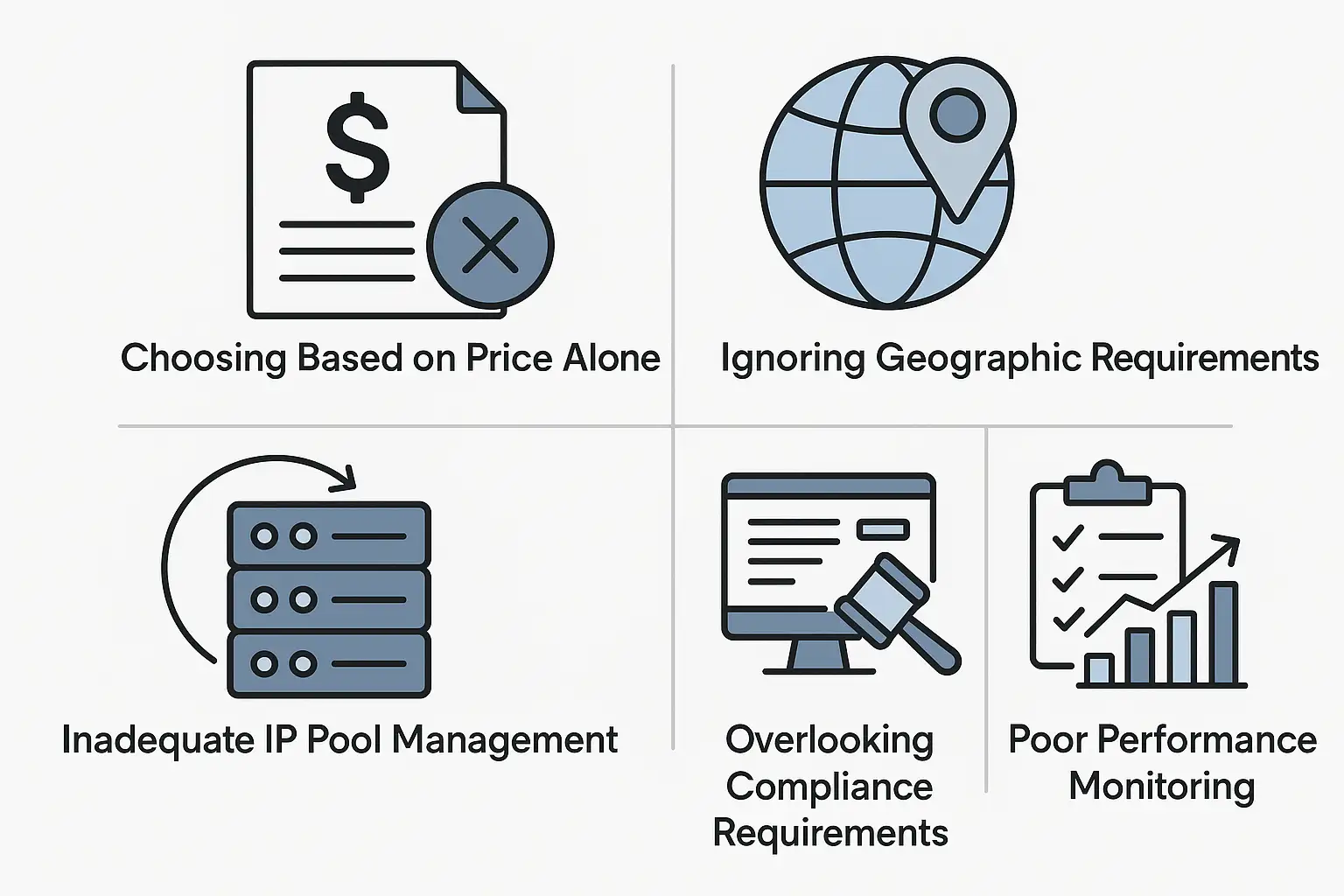
You can save time, money, and frustration by learning from others’ experiences. Here are the most common mistakes people make when buying and using data center proxies:
a. Choosing Based on Price Alone
The Mistake: Selecting the cheapest option without considering performance and reliability
Why It’s Problematic:
- Cheap proxies often have poor uptime
- Limited bandwidth can bottleneck your applications
- Inadequate support when issues arise
Better Approach:
- Calculate total cost of ownership including potential downtime
- Test performance during trial periods
- Factor in support quality and response times
b. Ignoring Geographic Requirements
The Mistake: Not considering where your proxy IPs are located
Why It’s Problematic:
- May trigger geo-blocking on target websites
- Could violate terms of service for certain platforms
- May impact data accuracy for location-sensitive applications
Better Approach:
- Map your target websites to required proxy locations
- Understand legal implications of different jurisdictions
- Test location targeting before committing to large volumes
c. Inadequate IP Pool Management
The Mistake: Using the same IPs repeatedly without rotation
Why It’s Problematic:
- Increases risk of IP bans and detection
- Reduces effectiveness of anonymization
- May violate rate limiting policies
Better Approach:
- Implement intelligent IP rotation strategies
- Monitor IP health and performance
- Maintain backup IP pools for continuity
d. Overlooking Compliance Requirements
The Mistake: Not understanding legal and ethical boundaries
Why It’s Problematic:
- Could violate website terms of service
- May breach data protection regulations
- Risk of legal complications
Better Approach:
- Review target website terms of service
- Understand applicable data protection laws
- Implement responsible scraping practices
e. Poor Performance Monitoring
The Mistake: Not tracking proxy performance and success rates
Why It’s Problematic:
- Miss opportunities for optimization
- Waste resources on underperforming IPs
- Difficulty troubleshooting issues
Better Approach:
- Implement comprehensive monitoring
- Track success rates, speed, and uptime
- Set up alerts for performance degradation
10. Frequently Asked Questions About Datacenter Proxies
Data center proxies are IP addresses hosted on high-speed servers in professional data centers. They reroute your internet traffic through their servers, providing faster connections than residential proxies but with a higher detection risk.
Datacenter proxies offer higher speeds and cost less, but websites can easily identify them. Residential proxies seem more legit but are slower (10-50 Mbps) and cost more per GB.
Yes, datacenter proxies are legal for legitimate purposes. Always comply with website terms of service and applicable laws when using them.
You can use it for web scraping, SEO monitoring, API testing, market research, and accessing geo-restricted content for business purposes.
Pricing varies by provider and model: $1-5 per IP monthly, $2-8 per GB bandwidth-based, or $50-200 per 100 concurrent connections.
Quality datacenter proxies typically deliver 100 Mbps to 1 Gbps speeds with 99.9% uptime guarantees.
Basic usage requires minimal technical knowledge. Most providers offer setup guides and customer support for configuration help.
Look for uptime guarantees, fast speeds, global coverage, responsive support, transparent pricing, and trial periods or money-back guarantees to test before committing.
11. Final Words
Buying data center proxies is a smart move that can really boost the success of your online operations. The key is understanding your specific needs, checking out the options, and picking solutions that balance performance, reliability, and cost-effectiveness.
Datacenter proxies are the best option for applications that need top-notch performance. They might not offer the same level of anonymity as residential proxies, but their top-notch infrastructure makes them perfect for web scraping, SEO monitoring, development testing, and business intelligence applications.
When picking a provider, keep in mind that the cheapest option isn’t always the best deal. When you’re thinking about it, there are a few key things to consider. First, how much time do they guarantee that the service will be up and running? Second, what’s the quality of their customer support? Third, how much of the country do they cover? And finally, what options do they have for growing their business? Take advantage of trial periods to test performance with your specific applications before making long-term commitments.
Tired of slow, unreliable proxies holding back your projects?
Boost your efficiency with our blazing-fast Datacenter Proxies—perfect for tasks like web crawling, price aggregation, and competitor analysis. Get unmatched uptime, low latency, and complete control over your operations with RapidSeedbox’s robust proxy network.
Good effort overall!! Looking forward to your next post!…
Thank you Marguerite! Coming soon!