 By
By
Bad data starts with bad geography – mismatched proxies cause pricing errors, stock confusion, and SEO chaos. RapidSeedbox’s geo-accurate proxies keep your scrapers aligned with the real world.
Table of Contents
- Geo-Accuracy: The Foundation of Truth in Retail Data
- Building Geo-Accurate Scraping Systems That Actually Work
- Real Scenarios from Retail Teams
- Why Retail Teams Use RapidSeedbox for Geo-Targeted Scraping
- FAQ: Geo-Targeted Web Scraping
- Final Words — Accuracy Builds Trust
1. Geo-Accuracy: The Foundation of Truth in Retail Data
Most scraping pipelines fail quietly. It starts small—an IP tagged to the wrong region. A data center says it’s in the U.S. but routes through Montréal. You scrape the same page twice and get different prices. Trust erodes fast.
Geo-accuracy is the backbone of clean data. It means your scraper matches the real-world location it’s targeting. Sites use IPs, geolocation, and even browser language to decide what to show. When those signals misfire, your data warps downstream.
In e-commerce, that distortion costs you:
- “Local discounts” that don’t exist in that region
- Products flagged out of stock, when they’re not
- Rankings that vanish because the IP came from the wrong city
The Hidden Enemies of Clean Data
Even if the dataset looks fine, small mismatches break everything from price tracking to SERP analysis. The usual suspects?
- Proxy geo-mismatch: The label says “US,” but the route says otherwise
- Dynamic geo-blocking: Sites hide or change content if the IP feels foreign
- Inconsistent rotation: IPs jump countries mid-session, faking randomness
🌍 Restore Confidence in Your Data — Geo-Accurate Results
Try RapidSeedbox’s Rotating Residential Proxies — real consumer IPs that deliver precise geo-targeting and dependable scraping accuracy across markets, backed by 24/7 support.
Get Geo-Accurate Proxies →2. Building Geo-Accurate Scraping Systems That Actually Work
Every data engineer eventually hits the same wall: you can’t trust data if you can’t trust where it came from. That’s where the “how” begins. In this section we’ll go through the technical details behind geo-targeted proxies, validation scripts, and careful architecture.
📊 Want data you can actually trust? Get the free Geo-Accurate Web Scraping System Checklist — your step-by-step guide to cleaner, region-verified insights. Download the Free Checklist Here
a. Start With Location Control
Sites respond differently depending on what country or city your IP (in this case your proxy’s IP) claims. Below is a diagram that shows how requests are geo-matched to region-specific proxies.
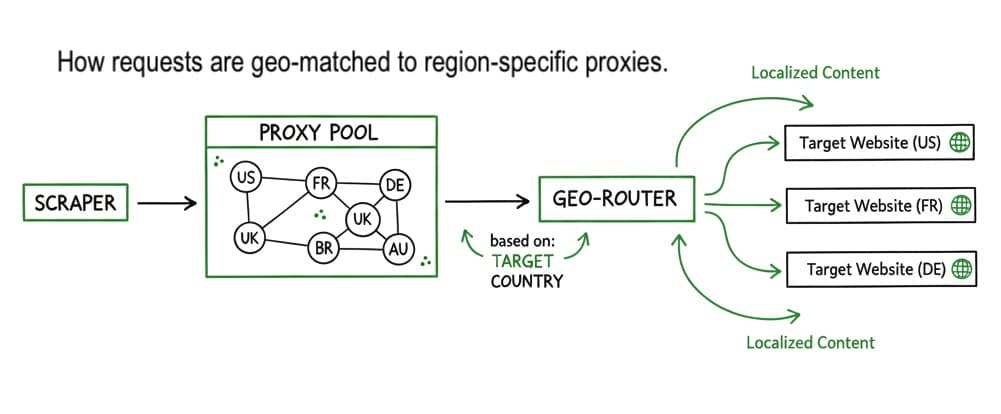
And so, the right setup starts here (without these, your scraper only sees ghost prices and phantom stock):
- Geo-targeted proxies simulate users from specific markets.
- Rotation control stops random hops between countries mid-crawl.
- Session stickiness keeps one IP stable long enough to finish a region-specific scrape.
- Validation confirms that your proxy’s IP actually resolves where it says it does.
- Build a geo-router: Route by target country/city/carrier. This is where you’ll decide sticky vs rotating logic, per-site rate limits, automatic failover.
Here’s a concise comparison table for the three best proxy types for geo-targeted web scraping:
| Proxy Type | Accuracy | Speed | Block Risk | Best Use Case |
| Rotating Residential | ⭐⭐⭐⭐☆ | ⭐⭐☆☆☆ | Low | Price tracking, localized SERP data |
| Mobile (4G/5G) | ⭐⭐⭐⭐⭐ | ⭐⭐☆☆☆ | Very Low | App data, social platforms |
| IPv6 Datacenter | ⭐⭐☆☆☆ | ⭐⭐⭐⭐⭐ | High | Large-scale scraping, bulk data |
b. Test Before You Scale
Never just trust a proxy label. So, always test it. The following simple Python snippet will help you beat a dozen assumptions.
|
1 2 3 4 5 6 7 8 9 10 11 12 13 14 15 16 17 18 19 20 21 22 |
import requests # Define your proxy PROXY = "http://user:pass@proxy_address:port" # Create a session and set proxies session = requests.Session() session.proxies.update({ "http": PROXY, "https": PROXY }) # Get the current IP via the proxy ip = session.get("https://api.ipify.org").text # Get geolocation info for that IP geo = session.get(f"https://ipinfo.io/{ip}/json").json() # Display IP, country, and city print(f"IP: {ip} | Country: {geo.get('country')} | City: {geo.get('city')}") |
If the output doesn’t match your target region, drop that proxy batch. This small check saves hours of debugging.
c. Scaling Accuracy with Tools You Already Use
Once validation is in your pipeline, it’s all about repeatable flow and smart tooling. Start by checking each proxy’s IP with a geolocation API or internal DB to confirm it matches your target region. Then enrich scraped locations with tools like Google Maps or ArcGIS to verify real-world accuracy. Before scaling, run test batches on new proxy pools to catch mismatches early. Automate cleanup by flagging high-variance sources when they cross your threshold.
You don’t need new tools—just better routines. Use Playwright or Selenium to emulate real locations in-browser. With Scrapy, tag requests by proxy region and save headers for traceability. Use Rotating Proxies with Requests to confirm IP accuracy. Automate it all in Airflow—nightly checks, audits, and zero manual review.
d. Keep Accuracy Alive: Monitoring & Audits
Geo-accuracy doesn’t usually break all at once. But instead, it fades quietly. IPs age and regions shift. Also proxy providers often recycle old space. That’s why monitoring is key for real maintenance.
So, how to keep it alive?
- Start by re-testing your proxy pools every week using a simple validation script.
- Then, log each IP’s region and ASN so you can automatically catch changes as they happen.
When you notice latency spikes or geo-database updates roll out, rotate your keys and clear caches to avoid false reads. And don’t forget your source lists—version them, and set a recurring audit every quarter.
| 🌍 Final Verdict: Fast is nice, but accurate is your key to survival. The best engineers build scrapers that know exactly where they stand (literally). By validating every proxy, logging each region, and anchoring datasets to real locations, they eliminate guesswork. That’s how geo-accuracy stops being a hope and becomes a guarantee. |
🌍 Stop Guessing — Start Scraping with Accuracy
Use RapidSeedbox’s Residential Proxies to get real-location data and clean, reliable results—every time.
Get Geo-Accurate Proxies →3. Real Scenarios from Retail Teams
One price-tracking team saw chaos: Brazil’s prices dropped, Argentina’s rose. Their scrapers worked—but proxies mislabeled traffic. After switching to geo-targeted IPs and validating each region, data accuracy jumped 30% overnight.
Another mapping team fixed false “out-of-stock” errors by tying proxies to verified regions—retries dropped 50%, and dashboards finally matched reality. A smaller firm saw API failures fall 40% after validating regions before merging data. Reliable results start with knowing where your data lives. In one case, RD Solutions Data uncovered MAP-pricing errors caused by regional gaps; with granular, location-based scraping across thousands of sites, compliance accuracy improved dramatically (source).
How geo-accuracy improves performance over time:
Refer to the following chart. As geo-targeted scraping (green line) is introduced, the Data Reliability Index rises sharply while the Operational Cost per Crawl steadily drops, showing measurable ROI and cleaner retail data from simple validation practices.

| ✅ Precision wins quietly. These aren’t massive overhauls. They’re small, disciplined fixes—checking proxy regions, testing IP accuracy, tagging every request by geography. That’s how competitive price tracking and availability mapping stop being guesswork. And how retail data teams move from noise to trust. |
Geo-Accuracy Delivers Business Wins Like These:
1. Real Pricing Intel:
Scrapes reflect the actual market. When a rival drops prices in Toronto (but not in Texas) you catch it instantly, and only where it matters.
2. Fewer Retry Loops:
Crawlers stop bouncing off geo-filters. That means fewer retries, lower bandwidth costs, and quicker cycles from scrape to insight.
3. Clean Data:
Machine learning runs on better ground truth. When input isn’t muddied by region errors, outputs don’t swing wildly.
4. Lower Dev Burnout:
Analysts stop flagging “bad data” that isn’t their fault. Engineers spend less time debugging false mismatches. Everyone gets hours back.
4. Why Retail Teams Use RapidSeedbox for Geo-Targeted Scraping
Pricing and search results change by geography (city, country), and also be carrier and even device. If your proxies aren’t local, your data’s wrong.
Most scraping fails because IPs resolve in the wrong place or get blocked easily. RapidSeedbox gives you residential, mobile, and datacenter proxies with real-world IPs that act like local users.

✅ What Retail Teams Get with RapidSeedbox
| Use Case | Proxy Type | Strategic Win |
|---|---|---|
| Localized Price Intelligence | Rotating Residential | Detect hidden markups, local discounts, and SKU gaps |
| MAP Monitoring & Compliance | Sticky Residential / IPv4 | Catch violations before they hurt your brand |
| Ad Verification | Mobile (3G/4G/5G) | Spot unauthorized or missing ads in real regions |
| Localized SEO & SERP Tracking | IPv4 Datacenter | Track rankings city-by-city, not just globally |
| Competitor Catalog Monitoring | IPv6 / Residential | Compare metadata, bundles, and visuals by region |
Need help? We’d be glad to walk you through the benefits of using our infrastructure for your needs!
Built for Scale and Accuraccy
- Geo-verified IPs in 100+ countries
- <0.5s latency for real-time SERP and product tracking
- Unlimited threads, 99.9%+ success rates
- Ethically sourced proxies and enterprise support
- Plug-and-play with Scrapy, Selenium, Playwright, Puppeteer
🌍 Rebuild Trust in Your Data with Precision
Experience RapidSeedbox’s Rotating Residential Proxies — real consumer IPs that deliver authentic geo-targeting and unmatched scraping accuracy across markets.
Try Now →5. FAQ: Geo-Targeted Web Scraping
Several layers can shift your data off target — IP location, proxy rotation, and how each site personalizes content. Even browser geolocation settings or hidden delivery rules can tilt results. The closer your IP and session mimic a real local user, the more accurate your scrape becomes.
Always test before you trust. Send a quick request to an IP-info API like ipinfo.io or ipapi.co before scraping. Compare the reported country or city with your target region. If they don’t match, don’t use it. It’s cheaper to discard a bad proxy than to clean bad data later.
Usually, yes. They use IPs from real consumer devices, which makes them harder to detect and more reliable for localized scraping. They aren’t magic, though—still test and rotate them carefully.
Stay under radar. Match proxies to the correct country, vary user-agents, throttle request speed, and respect the site’s limits. Compliance keeps access stable longer than brute force ever will.
It’s about truthful data, not just speed. Test proxies, respect robots.txt, stay within limits, and avoid personal info. Precision matters—but so does playing by the rules. That’s how you earn trust and keep your data reliable.
5. Final Words.
Every dataset tells a story. The question is whether it’s the right one. Geo-accuracy makes that story real. It keeps your numbers grounded in the places they claim to describe. It turns vague signals into clear decisions.
When a proxy drifts, your confidence drifts with it. Yet when you track and verify, the noise settles. Reports line up with what the market actually shows. This is where strong engineering lives.
So, here is a quick summary:
- Validate your regions.
- Monitor the small shifts.
- Keep every crawl connected to the real world.
Clean data speaks steadily, through consistency and care. That’s what geo-accuracy gives you—a foundation you can build on without second-guessing every result.
0Comments