 By
By
Are funding rounds missing? Is your headcount data drifting? Crunchbase is a core source for company intelligence, but reliably collecting its public data is harder than it looks. Read on to learn how research and investment teams can scrape Crunchbase without encountering blocks, gaps, or unreliable snapshots.
Table of Contents
- Crunchbase Powers Decisions, Not Just Databases
- Why Crunchbase Pushes Back on Automation
- How to Scrape Crunchbase Safely and Reliably
- What Reliable Crunchbase Data Enables for the Business
- Why Teams Choose RapidSeedbox for Crunchbase Scraping
- Ready to Scrape Crunchbase Without Data Gaps?
- FAQ
Crunchbase Powers Decisions, Not Just Databases
If you work in market research, venture analysis, or B2B intelligence, Crunchbase is likely where you start to understand companies on a large scale.
Consistently collected Crunchbase data supports the following:
- Market sizing and sector analysis
- Startup discovery and trend spotting
- Funding round tracking
- Investor activity analysis
- Headcount growth signals
- Competitive landscape mapping
- Sales territory and account prioritization
However, most teams don’t anticipate the problems that arise from scraping Crunchbase at scale.
- Access throttling after a few pages
- Empty or partially loaded company profiles
- Funding data lagging behind visible updates
- Pagination that stops unexpectedly
- Session resets mid-crawl
- Inconsistent company counts between runs
If your Crunchbase feed becomes unreliable, the credibility of your downstream insights will quickly decline.
Why Crunchbase Pushes Back on Automation
Crunchbase data is commercially valuable. Consequently, the company closely monitors how its public pages are accessed.

The following signals are commonly evaluated:
- IP reputation and reuse
- Session length and navigation flow
- Page-to-page velocity
- Browser fingerprint consistency
- Repeated filter and search patterns
- Parallel requests across the same subnet
Rather than using obvious hard blocks, Crunchbase often uses soft resistance.
- Loading spinners that never resolve
- Partial company cards
- Funding sections failing to render
- Pagination that silently stops
- Results that change between identical searches
These failures are subtle and dangerous because they appear to be “real data” until you compare runs.
How to Scrape Crunchbase Safely and Reliably
To safely scrape Crunchbase, use residential proxies with stable sessions, real browser automation to render dynamic components, and conservative request pacing. Focus only on publicly accessible company data, and monitor for partial loads or pagination cutoffs to ensure your datasets are trustworthy.
1. Use Residential Proxies with Sticky Sessions
Crunchbase expects browsing patterns that resemble those of analysts or researchers rather than crawlers.
Residential proxies help by:
- Reducing suspicion compared to data center IPs.
- Supports longer, uninterrupted sessions.
- Lower throttling during pagination.
- Improve consistency when filtering by industry, funding stage, or geography.
Sticky sessions are essential. Switching to a different IP address while navigating often causes Crunchbase to reset the results or hide sections.
2. Render Company Pages with a Real Browser
Crunchbase loads many fields dynamically, especially on company profiles.
Static requests often miss:
- Funding round breakdowns
- Investor lists
- Acquisitions history
- Employee range indicators
- Similar companies modules
Use Playwright or Puppeteer to render pages as a real user would:
|
1 2 3 4 5 6 7 8 9 10 |
from playwright.sync_api import sync_playwright with sync_playwright() as p: browser = p.chromium.launch(headless=False) page = browser.new_page() page.goto("https://www.crunchbase.com/organization/example-company") page.wait_for_timeout(3000) html = page.content() browser.close() |
This ensures that all visible public fields are loaded before extraction.
3. Slow Down Navigation and Pagination
Crunchbase tracks how quickly users move between pages.
Some safe patterns include:
- 2-4 seconds between page loads
- Pauses after opening the Funding or Investors tabs.
- Limited number of filter changes per session.
- Avoiding rapid jumps between unrelated companies
Avoid:
- Scraping hundreds of profiles per minute.
- Parallel crawls from one IP address.
- Repeatedly replaying identical searches
- Programmatic page jumps without scrolling or delay.
Patience, not speed, is the key to stability.
4. Collect Only Publicly Visible Crunchbase Fields
Your scraper should only capture information that’s available without logging in.
Public data typically includes:
- Company name
- Description
- Industry categories
- Location
- Founding year
- Funding totals (when public)
- Public funding rounds
- Investors (publicly shown)
- Employee range (if visible)
- Website and social links
Avoid:
- Paid-tier fields
- Account-only analytics
- Export-restricted datasets
- Internal rankings or scores
Keeping your workflow compliant and sustainable means staying within public access.
5. Monitor for Partial Data and Snapshot Drift
Crunchbase scraping often fails silently.
Watch for:
- Missing funding sections
- Sudden drops in company counts
- Empty investor lists
- Inconsistent employee ranges
- Pagination ending early
- Changes in DOM structure
- Increased load times (early throttling signal)
If today’s data appears “complete but different” from yesterday’s, assume there was an issue with the data scraping, not a market shift.
What Reliable Crunchbase Data Enables for the Business
Intelligence teams can work faster and with more confidence when Crunchbase data is stable.
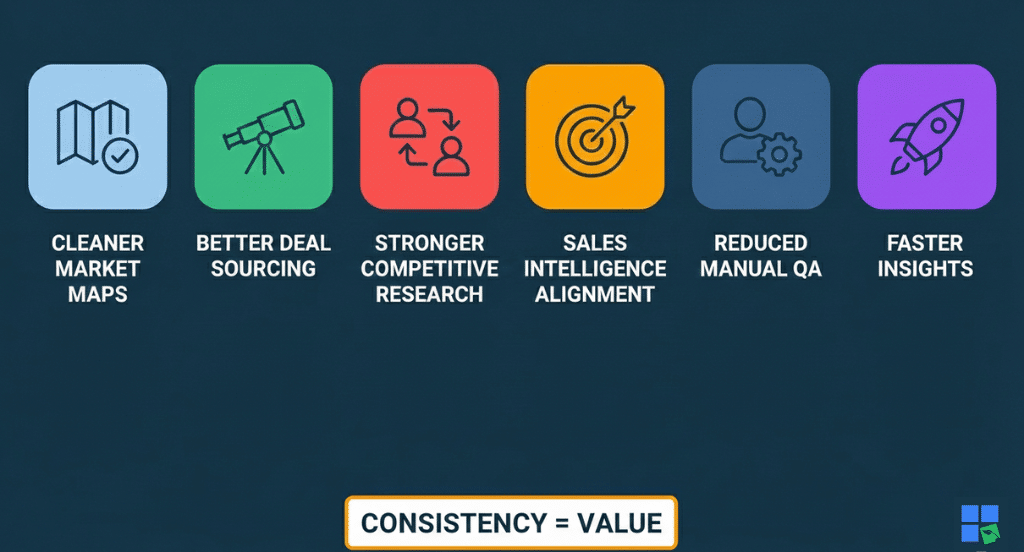
Cleaner Market Maps
Accurate company counts are key to improving sector analysis.
Better Deal Sourcing
Identify emerging startups and funding trends earlier.
Stronger Competitive Research
Understand who is raising, hiring, or consolidating.
Sales Intelligence Alignment
Prioritize accounts based on funding and growth signals.
Reduced Manual QA
Analysts trust the output when there are fewer broken scrapes.
Faster Insight Delivery
Reliable pipelines can shorten research cycles.
Crunchbase data is only valuable when it’s consistent.
Why Teams Choose RapidSeedbox for Crunchbase Scraping
Crunchbase scraping isn’t about raw volume. Rather, it’s about session stability and predictable access.
RapidSeedbox supports this with:
- Clean residential IP pools
- Sticky session control
- Low throttling rates
- Transparent dashboards
- Human technical support
- Test-first onboarding
Ready to Scrape Crunchbase Without Data Gaps?
If Crunchbase is essential to your research, sales intelligence, or investment analysis, unreliable data is not an option. RapidSeedbox provides the necessary infrastructure and support to reliably scrape public Crunchbase data.
FAQs
While you may collect publicly visible company data, you must comply with Crunchbase’s terms of service and applicable laws.
Inconsistencies are often caused by soft throttling, session resets, and partial loads.
Residential proxies with sticky sessions.
Market research is weekly, while fast-moving funding analysis is daily.
Common signs include missing funding sections, early pagination stops, and inconsistent totals.
Disclaimer: This content is for educational purposes only. RapidSeedbox does not encourage violating any website’s Terms of Service. Users are responsible for ensuring their data practices comply with applicable laws and policies.
0Comments