 By
By
Want to know what your competitors are charging – right now, not next week?
That’s the holy grail of price intelligence, and the gateway to mastering modern marketplaces like Amazon and eBay. This guide walks you through how to scrape these platforms safely, collect structured price data, beat anti-bot systems, and stay on the right side of compliance. By the end, you’ll know how to build a resilient price-monitoring engine that actually helps you make smarter moves.
👉 Quick start: Run your scraper on rotating residential – it’s the difference between clean data and constant bans.

TL;DR / Table of Contents
- Why Price Intelligence Isn’t Optional Anymore: Prices on Amazon and eBay change by the second — if you’re not tracking them in real time, you’re already behind.
- What Is Pricing Intelligence Scraping (and How It Works for Amazon & eBay): A streamlined system that collects and structures marketplace data so you can react fast and price smarter.
- How Amazon & eBay Display Price Data (and Where to Find It): Each site hides key pricing signals in different places — knowing where to look saves hours of bad scraping.
- Building a Reliable Scraping Engine: Use the right tools, proxies, and throttling logic to build a scraper that scales without getting banned.
- Legal & Compliance Boundaries: Scraping public data isn’t illegal, but it’s restricted. Stay within access limits and respect platform terms.
- Practical Workflows: Scraping Amazon & eBay for Pricing (Python): Step-by-step workflows show how to extract product prices cleanly using Python and structured pipelines.
- Common Pitfalls to Avoid: From over-scraping to weak proxies, small mistakes can ruin your data — learn what breaks scrapers and how to prevent it.
Content Disclaimer: This article is for educational and informational purposes only. It does not provide legal advice. Readers are responsible for ensuring their scraping practices comply with all applicable laws, regulations, and platform terms.
1. Why Price Intelligence Isn’t Optional Anymore
Every blink, someone’s price shifts on Amazon or eBay. There are thousands of sellers, thousands of tweaks, so such changes become inevitable. Also, algorithms trade blows faster than you can refresh the page. If your system hesitates (even for a breath) you will drop. Your visibility is gone, and profits fade.
Price intelligence keeps you in the game. It lets you:
- 🧭 See what competitors charge — live.
- 📊 Catch undercutting before it costs you.
- 🚀 Adjust your prices fast, not late.
- 💡 Spot demand swings and cost changes early.
The stakes? Real money. But don’t stop at the checklist. This isn’t just about staying even. It’s about control — or losing it.
Here’s what’s really going on:
One study (source: arXiv) showed that sellers using frequent repricing (even with messy data) made over 20% more than those with slow or static strategies. Especially in markets like Amazon, where a dozen big players circle each other, always testing and reacting. So, it turns out, speed is everything. Also, consider the retail bleed-over. The “Amazon Effect” didn’t stay online. Brick-and-mortar stores are now copying the same dynamic pricing behavior (forced into it, really) which means the standard for digital sellers keeps climbing. What this means? You can’t just be competitive, you have to be anticipatory.
In the end, good pricing tools don’t just compare numbers. They spot habits — when prices drop, how long they stay low, when stock runs dry. That turns reaction into prediction. So here’s the blunt truth: If your pricing data isn’t fresh, and your strategy isn’t adaptive, you’re not competing. You’re just watching the others play.
2. What Is Pricing Intelligence Scraping (and How It Works for Amazon & eBay)
Pricing intelligence scraping means automatically pulling product and offer data from marketplaces like Amazon and eBay. The goal? Track prices, Buy Box winners, and overall monitor the market shifts fast enough to make smart pricing moves.
At a high level, it’s a pipeline:
Data Sources → Scraper Layer → Storage → Intelligence Platform.

a. Data Sources — Amazon & eBay: It starts with the raw data. The scraper targets search and product pages (ASINs, Buy Box prices, and sellers). Pagination lets it sweep through full result sets instead of stopping at page one.
b. Scraper Layer: This is the engine. It sends requests and renders pages. It should also hide from anti-bot systems using tech like proxy rotation and user-agent changes. For JavaScript-heavy pages, Playwright or Puppeteer does the lifting. It also cleans the data — normalizing prices, timestamps, and key fields before storage.
c. Raw Data Storage: Cleaned data lands in a warehouse or object store. Deduping by ASIN or Item ID removes repeats. But it should also soft delete to preserve listing history. Change tracking flags every price or stock update for downstream use.
d. Pricing Intelligence Platform: This is where raw data becomes a strategy. It benchmarks prices and Buy Box shares. It can also highlight undercutting or stock-out gaps, and generates pricing moves that balance margin with competitiveness.
3. How Amazon & eBay Display Price Data (and Where to Find It)
Amazon and eBay are the two biggest sources of retail truth online. They look similar from the outside (endless product grids, shifting prices) but under the hood, they speak very different data languages.
Knowing the difference saves you hours of debugging and weeks of bad intel.
Amazon: The World’s Most Scraped Marketplace
Each Amazon search result page is a data goldmine. Every product block has a unique data-asin attribute — that’s your key to mapping listings.

On the product page, the Buy Box tells you who’s winning right now. That’s the seller Amazon favors, and the one most buyers choose. Look for:
- Title → id=”productTitle”
- Price → span.a-price-whole and span.a-price-fraction
- Seller → near “Add to Cart” button
- ASIN → in the URL or hidden fields
| 🔑 Pro Tip: Over 90% of Amazon purchases happen through the Buy Box. If you’re not tracking the Buy Box winner, you’re missing the main signal that drives sales velocity. |
eBay: The Hybrid Data Landscape
eBay’s a different beast, half structured and half chaos. Some listings are neat, machine-readable. Others look like someone copy-pasted a garage sale flyer. The structured data (brand, model, color) often hides in JSON-LD <script> blocks. Unstructured details live in plain HTML descriptions, so you’ll need to handle both.
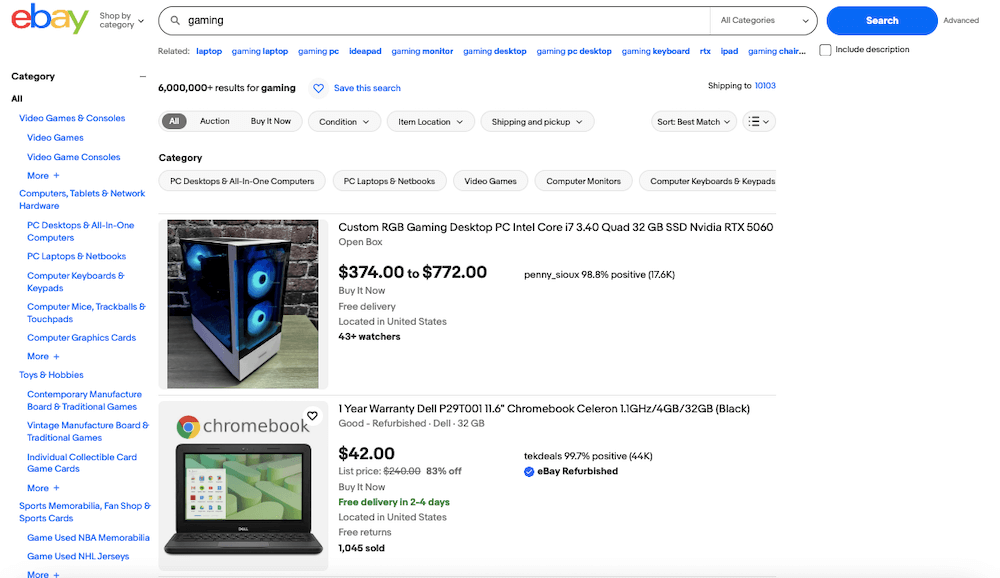
Key selectors should include:
- Title → #itemTitle or .s-item__title
- Price → span.s-item__price
- Seller → a.mbg-nw
- Search pagination → &_pgn=N
| And remember: eBay supports both auction and Buy-It-Now formats. Your scraper needs logic to detect which one you’re parsing. |
Build a Stable Scraping Stack 🧠
Strong proxies mean fewer errors, cleaner data, and safer price intelligence scraping at scale.
Explore Residential Proxies →4. Building a Reliable Scraping Engine
Don’t build a toy. Build something that keeps running. Something that keeps honest data and won’t get you blocked on day two. In this section, we will go through the practical choices; the tools that fit the job and patterns that survive anti-bot defenses. Pick a path and ship a scraper that actually earns its keep.
Price Intelligence Scraper Architecture (refer to the image below)
- Acquisition: The system starts by collecting product data from e-commerce sources like Amazon and eBay through APIs or HTML pages. This is managed by a request orchestrator that controls speed, retries, and concurrency.
- Processing: Data is fetched through rotating proxies and headless browsers, then parsed, validated, matched across listings (ASIN ↔ Item ID), and normalized for price, tax, and condition.
- Storage: Cleaned data is stored in three tiers: Raw, Curated/Gold, and Warehouse/Lakehouse. This is for traceability and scalability.
- Delivery: Finally, the Insights are visualized through dashboards or exported via APIs, CSVs, or webhooks into business tools like ERP, PIM, or repricing engines.

Step 1: Pick the Right Tools
For lightweight scrapes, use Python + Requests + BeautifulSoup or lxml. For dynamic pages (JavaScript-heavy), go headless: Playwright or Puppeteer. But if you are working for enterprise scale, use Scrapy or Crawlee with proxy middleware.
| Tool | Language | Best For |
| BeautifulSoup | Python | Small, static pages |
| Playwright | Python / Node.js | JS-heavy pages |
| Scrapy | Python | Scalable crawling |
| Puppeteer | Node.js | Browser automation |
✅ Quick win: Use ScraperAPI, RapidSeedbox’s Proxy, or Crawlbase to outsource proxy rotation and CAPTCHA handling.
Step 2: Handle Pagination & Variations
Amazon’s search URLs paginate with &page=N, and eBay’s with &_pgn=N. Loop through these values to cover all results.For product variations (size, color, bundle):
- On Amazon, each variant often has its own ASIN — simulate selection or fetch via API.
- On eBay, use Selenium or Playwright to click dropdowns dynamically and reveal hidden SKUs.
⚡ Common mistake: Scraping only the default variant — you’ll miss up to 30% of listings.
Step 3: Beat Anti-Bot Systems
Both Amazon and eBay deploy aggressive defenses. Think defenses such as: IP throttling, Browser fingerprinting, User-agent filtering, and CAPTCHAs
To stay undetected:
- 🔄 Rotate proxies (residential or mobile > datacenter).
- 🧭 Randomize user agents and headers.
- ⏳ Throttle your requests — mimic human browsing speed.
- 🧩 Integrate CAPTCHA solvers (2Captcha, Anti-Captcha).
❝Scraping isn’t about speed — it’s about endurance. The slower, smarter scraper wins.❞
Proxy rotation example:
|
1 |
browser = p.chromium.launch( headless=True, proxy={"server": "http://USER:PASS@proxyserver:port"} ) page.set_user_agent("Mozilla/5.0 ... Safari/537.36") |
👉 Need reliability? Use a provider offering rotating residential with sticky sessions (RapidSeedbox).
5. Legal & Compliance Boundaries
Scraping public e-commerce data sits in a gray zone (not illegal! but tightly limited). The key difference here, you need to think of is access versus permission. Courts have ruled that collecting public info like prices or titles can be lawful if it’s responsible and non-disruptive. Still, breaking a site’s Terms of Service can trigger bans.
a. Terms of Service
Both Amazon and eBay forbid automated scraping without permission. Violations can trigger IP bans or account suspensions. But U.S. case law (e.g. HiQ Labs vs. LinkedIn) has established that scraping public data is not inherently illegal, provided it doesn’t harm or disrupt services.
✅ Safe practices:
- Only target public product data (no login areas).
- Respect robots.txt when feasible.
- Add random delays between requests.
- Avoid republishing copyrighted text (e.g. reviews).
b. International Considerations
| Region | Guideline | Key Note |
| 🇺🇸 USA | CFAA doesn’t ban public scraping | Avoid private data |
| 🇪🇺 EU/UK | GDPR applies if personal data collected | Product data = OK |
| 🌏 APAC | Varies; often vague or untested | Use compliant proxies |
💡 If in doubt, always consult legal counsel when scraping across borders or reselling data.
6. Practical Workflows: Scraping Amazon & eBay for Pricing (Python)
How to read this: Each workflow follows a two-stage pipeline —
- Discovery (collect unique IDs/URLs from search results), then
- Detail (open each product page to extract Buy Box/price fields).
This separation avoids redundant requests and simplifies retries. This is also perfect if you are looking to play nicer with rate limits. Add headers, delays, and (when needed) rotating proxies.
Example: Amazon Scraping Workflow (Python)
|
1 2 3 4 5 6 7 8 9 10 11 12 13 14 15 16 17 18 19 20 21 22 23 24 25 26 27 28 29 30 31 32 33 34 |
# Discovery → Detail pattern for Amazon import time, random, requests from bs4 import BeautifulSoup HEADERS = {"User-Agent": "Mozilla/5.0"} BASE = "https://www.amazon.com" def discover_asins(query, pages=1): asins = set() for p in range(1, pages + 1): url = f"{BASE}/s?k={query}&page={p}" resp = requests.get(url, headers=HEADERS, timeout=20) soup = BeautifulSoup(resp.text, "lxml") page_asins = [d["data-asin"] for d in soup.select("div[data-asin]") if d.get("data-asin")] asins.update(page_asins) time.sleep(random.uniform(1.5, 3.5)) # polite delay return list(asins) def fetch_buybox_price(asin): url = f"{BASE}/dp/{asin}" resp = requests.get(url, headers=HEADERS, timeout=20) s = BeautifulSoup(resp.text, "lxml") price_w = s.select_one("span.a-price-whole") price_f = s.select_one("span.a-price-fraction") if price_w and price_f: return f"{price_w.text}{price_f.text}" return None # Run asins = discover_asins("headphones", pages=2) for asin in asins: price = fetch_buybox_price(asin) if price: print(f"{asin}\t${price}") |
🔑 Key takeaways:
- Separate ASIN collection (list view) from detail scraping.
- Add delays/retries; plug in proxies if you hit throttling.
Example: eBay Scraping Workflow (Python)
|
1 2 3 4 5 6 7 8 9 10 11 12 13 14 15 16 17 18 19 20 21 22 23 24 25 26 27 28 |
# Discovery (search pages) with pagination → extract listings import time, random, requests from bs4 import BeautifulSoup HEADERS = {"User-Agent": "Mozilla/5.0"} def discover_ebay_listings(query, pages=2): items = [] for p in range(1, pages + 1): url = f"https://www.ebay.com/sch/i.html?_nkw={query.replace(' ', '+')}&_pgn={p}" resp = requests.get(url, headers=HEADERS, timeout=20) soup = BeautifulSoup(resp.text, "html.parser") for li in soup.select("li.s-item"): title = li.select_one("h3.s-item__title") price = li.select_one("span.s-item__price") link = li.select_one("a.s-item__link") if title and price and link: items.append({ "title": title.get_text(strip=True), "price": price.get_text(strip=True), "url": link["href"] }) time.sleep(random.uniform(1.5, 3.0)) return items results = discover_ebay_listings("vintage camera", pages=2) for r in results: print(r["title"], r["price"], r["url"]) |
⚙️ Notes:
- This pulls titles, prices, and URLs from search results.
- Add &_pgn= for multi-page coverage; open each item URL for seller, condition, shipping, and total price.
- For tougher pages, switch to Playwright/Puppeteer and use rotating proxies + short sticky sessions for variant/cookie continuity.
7. Common Pitfalls to Avoid
Even solid pricing intelligence setups can fall apart from small, preventable mistakes. A broken scraper doesn’t just slow things down — it pollutes your data, gets your IPs banned, and drags you into compliance trouble. Here’s what to watch for — and how to dodge it.
- ⚠️ Over-scraping without pauses: Blasting thousands of requests per second might feel fast, but platforms like Amazon and eBay notice instantly. They flag spikes. So, we recommend you slow down. Use adaptive throttling, batch requests, and random delays so your traffic looks human, not scripted.
- ⚠️ Cheap or free proxies: Free proxy lists? Don’t. They’re reused, slow, dangerous and often blacklisted. Pay for rotating residential or mobile proxies with health checks and latency, success rate. It’s cheaper than getting your scraper blocked mid-run.
- ⚠️ Ignoring layout changes: Sites evolve quietly. One new <div> and your scraper dies. Static selectors break fast. Add schema validation and fallback rules. Also, consider auto-retraining logic so you catch layout changes before they wreck your pipeline.
- ⚠️ No logging or retry logic: When errors vanish into the void, debugging turns into guessing. Centralize your logs with tools like ELK or Datadog. Add retry logic with backoff timers. It’s how you tell whether the problem’s your proxy, the network, or the page itself.
- ⚠️ Pushing legal or ethical limits: Scraping public data can be fair game — scraping in defiance of terms of service isn’t. Stick to publicly visible info, and use official APIs when possible. You’ll stay compliant and sleep better.
| 💡 Pro Insight: The best teams treat scrapers like production systems. They audit, rotate proxies, and monitor compliance — not just to stay online, but to stay sharp. |
8. Price Intelligence: FAQ
Because scraping Amazon or eBay at scale triggers anti-bot systems. Without rotating and diverse IPs, requests get blocked. Using residential or mobile proxies with session control ensures stable connections and consistent data collection.
Use a mixed strategy: Datacenter proxies for fast discovery, Residential proxies for stealth on product detail pages, and Mobile proxies for tasks that mimic real-user activity or social signals.
Track latency, ban rate, and success percentage regularly to detect failing IPs and adjust rotation or retry logic before performance drops.
Because unstructured data is difficult to analyze. Organizing it into fields like Product, ASIN/eBay ID, Price, Seller, and Timestamp enables seamless integration with BI tools, turning raw data into actionable pricing insights.
Because manual scraping can’t keep up with dynamic pricing at scale. Automation ensures continuous, consistent data collection — scheduling, fetching, parsing, and storing — without human intervention, which saves time and prevents data gaps.
By combining scraped data with official APIs like Amazon SP-API or eBay API. This hybrid approach enhances data reliability, ensures compliance with platform policies, and reduces the risk of IP bans.
Closing Reflection
Price intelligence is no longer optional — it’s competitive survival.
With the right proxy infrastructure, responsible scraping methods, and legal awareness, you can transform raw listings into actionable insights that move revenue needles.
So ask yourself:
Are you still guessing your competitors’ prices — or are you watching them in real time?
👉 Next step: Build your proxy-powered scraping stack today and make price data your competitive edge.
Go Human-Like on Amazon & eBay 📶
Residential proxies make your price intelligence scraping appear like real user traffic — not bots.
Try Mobile IPs →
0Comments