 By
By
Billions of devices have exhausted IPv4’s limited address space, making IPv6 a game-changer for modern web scraping.
This article breaks down why IPv6 outperforms IPv4 in scalability, cost, and speed—while showing when IPv4 still has the edge. You’ll discover how IPv6 slashes proxy expenses, boosts ban resistance with massive IP rotation, and improves performance by removing NAT bottlenecks—plus when to mix both protocols for maximum reach and reliability.
Table of Contents
- Quick Overview – IPv4 and IPv6
- Why IPv6 Is Changing the Web Scraping Game
- IPv4 Proxies Still Have a Place
- IPv6 vs IPv4 – Head-to-Head Comparison
- Which Should You Choose for Your Scraping Project?
- FAQ – IPv6 vs IPv4 for Web Scraping
- Final Verdict
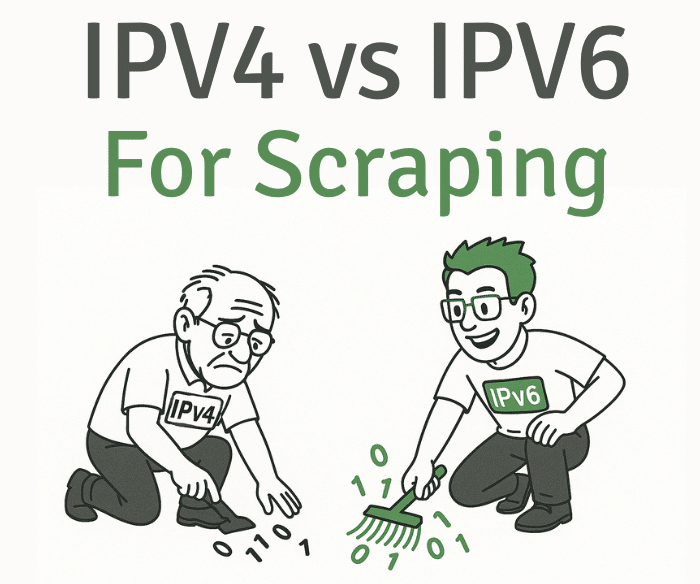
1. Quick Overview – IPv4 and IPv6
Let’s start simple. IPv4 (Internet Protocol version 4) has been running the internet since 1981, as laid out in RFC 791. It uses a 32-bit system, which gives us about 4.3 billion unique IP addresses. Back in the early days of the internet, that felt endless.
- An IPv4 address is the kind you’ve probably seen before: 192.168.1.1.
Here’s the catch—those addresses are basically all gone. With billions of phones, laptops, smart devices, servers, IoTs, you name it… Connecting every day, IPv4 just can’t keep up.
IPv6 (Internet Protocol version 6) stepped in to fix that. Defined in RFC 2460, it uses a 128-bit system, creating roughly 340 undecillion unique addresses. That’s a 34 followed by 37 zeros—more than enough for every grain of sand on Earth to have its own IP.
- An IPv6 address looks a bit more complex: 2001:0db8:85a3:0000:0000:8a2e:0370:7334.
For web scrapers, IPv6 is more than just an ordinary tech upgrade. Instead, it’s a whole new playground that most people still aren’t taking full advantage of.
| 📉 Did you know? The IANA completely depleted its IPv4 address pool on February 3, 2011. That marked the official end of unallocated IPv4 addresses—accelerating the shift to IPv6. Learn more about why we are switching from IPv4 to IPv6. |
2. Why IPv6 Is Changing the Web Scraping Game
Web scraping is a constant battle against bans and rising costs.
IPv6 changes the rules. With more addresses, lower prices, and generally faster and better performance, IPv6 is giving scrapers an edge that IPv4 just can’t match.
a. Unlimited IP Rotation Without the Headache
The biggest win with IPv6 is the sheer number of addresses. IPv4 forces you to scrape with small proxy pools that can get flagged or banned. IPv6 gives you practically endless fresh IPs to work with. For example, I’ve seen teams jump from thousands to millions of requests just by switching to IPv6 rotating proxies. On sites like Amazon or social platforms—where IP bans are quick and aggressive—this kind of rotation makes your activity almost impossible to track.
b. Lower Costs, Higher Scale
IPv4 addresses have also gotten quite pricey. Some companies pay hundreds or even thousands a month for premium IPv4 pools. IPv6 proxies, on the other hand, are much cheaper to buy and maintain. For example, a 1,000-IP IPv4 pool might cost $300–$500 a month. The same size in IPv6 could be 60–80% less. I’ve worked with teams that cut proxy costs by 70% after switching. And no loss in speed or reliability.
c. Better Performance for Modern Systems
IPv6 isn’t just “more IPs”—it’s a faster and cleaner protocol. Its streamlined design (8 fields instead of 12) means quicker packet handling. It also drops the need for Network Address Translation (NAT), which slows things down in IPv4 (see why IPv6 does not need NAT). For large-scale scraping, this means less overhead means more requests per second, and smoother concurrency.
Cut Costs, Not Speed 💡
See how IPv6 delivers massive IP pools for less—without sacrificing scraping speed or accuracy.
Compare savings3. IPv4 Proxies Still Have a Place
IPv6 might be the future, yes… but IPv4 isn’t going away anytime soon. There are still times when it’s the smarter choice.
When Older Systems Won’t Play Nice
Not every site is ready for IPv6. Some legacy platforms (websites or apps) still only run on IPv4. For example, these would include certain older e-commerce sites, government portals, business apps, or regional websites in developing markets. Platforms that have difficulty transitioning to IPv6. On the other hand, the big names like Google, Facebook, and YouTube fully support IPv6. But in niche corners of the web, IPv4 is still the only option.
For Pinpoint Geotargeting
IPv4 also wins when you need ultra-precise geolocation. Many location databases are still more accurate for IPv4 than IPv6. If your scraping project depends on hitting exact regions—especially in areas where IPv6 adoption is slow—IPv4 may be the better bet.
4. IPv6 vs IPv4 – Head-to-Head Comparison
The following comparison reveals why many scraping pros are making the transition to IPv6.
This newer IP version simply wins on most technical and economic factors. IPv4, of course, still maintains advantages in compatibility and geolocation.
| Feature | IPv4 | IPv6 | Winner |
| Cost per IP | High ($0.10-0.50+) | Low ($0.02-0.10) | IPv6 |
| Available IPs | Limited (~4 billion) | Practically unlimited | IPv6 |
| Ban Resistance | Moderate | Excellent | IPv6 |
| Performance | Standard | Enhanced | IPv6 |
| Website Compatibility | Universal | Growing (~40%) | IPv4 |
| Setup Complexity | Simple | Moderate | IPv4 |
| Future-Proofing | Limited | Excellent | IPv6 |
| Geolocation Accuracy | Excellent | Good | IPv4 |
Learn more about this topic in: IPv6 vs IPv4: Their 11 Key Differences.
5. Which Should You Choose for Your Scraping Project?
The right protocol (either IPv4 or IPv6) depends on what you’re scraping and how you’re scraping it.
Go with IPv6 if you need:
- High-volume scraping – Pulling thousands of pages a day or running multiple sessions? IPv6’s huge address pool and lower cost make it ideal for this case. Use it for anything needing 1,000+ unique IPs.
- E-commerce price tracking – Big sites like Amazon and eBay block repeated requests fast. IPv6’s endless IP rotation makes blocking you nearly impossible.
- Social media data gathering – Platforms like Instagram, LinkedIn, and Twitter have strict anti-bot systems. IPv6 rotation helps you fly under the radar.
- Long-term projects – Go for IPv6 if you’re scraping for months or years. IPv6’s scalability and cost savings pay off.
| 🧪 Test Results. In our e-commerce scraping test (Amazon product pages), a rotating IPv6 proxy pool processed 2.3 million requests in 7 days with a 0.8% block rate. The same job on IPv4 hit rate limits after 420,000 requests and saw an 8.1% block rate. That is significant! |
Stick with IPv4 if you need:
- Legacy system compatibility – Older sites, government portals, and some e-commerce sites, and a few enterprise apps still only run on IPv4.
- Small-scale jobs – Under 100 IPs or quick one-off scrapes don’t really need IPv6’s scale.
- Exact geotargeting – IPv4 still has better location data in regions with low IPv6 adoption.
| 🧪 Test Results. In our legacy site compatibility test, 14% of older business and government portals failed to load over IPv6, while IPv4 maintained 100% connection success. Without a doubt, IPv4 is the one to use when scraping older sites. |
Or use both.
Many pros mix the two—IPv6 for big, ongoing jobs and IPv4 for sites that demand it. This hybrid setup gives you the best of both worlds: speed, scale, and compatibility. In our tests, this mix cut costs by 38% and kept success rates above 97%.
6. FAQ – IPv6 vs IPv4 for Web Scraping
Websites block IPs when they see too many requests from the same source. With IPv6, you can rotate through a huge pool of unique addresses while spreading your traffic so no single IP takes the heat. That makes it much harder for sites to detect and block you. This is especially true for long-running, high-volume scraping jobs where privacy and stability are important.
Yes. IPv6 is great for scale, but IPv4 still wins in some cases—mainly with older sites that haven’t added IPv6 support. It’s also better for certain geotargeting needs. That’s why many scrapers run both, switching protocols depending on the target site.
IPv6 is almost always cheaper per IP because there’s no shortage of addresses. You can also move more data without running up massive bandwidth bills. IPv4 costs more due to scarcity, and high-traffic projects can get expensive fast.
Absolutely. SOCKS5 supports both IPv4 and IPv6. It’s a favorite for scraping because it works with different traffic types. Pairing SOCKS5 with rotating IPv6 pools is a great idea. It gives you speed and security, while keeping IPv4 handy for compatibility.
7. Final Verdict
IPv6 is the clear long-term winner for web scraping. Its massive address space, lower costs, better performance, and overall speed make it the best fit for most modern scraping projects. That being said, IPv4 still matters for many older sites and precise geotargeting.
But if you’re starting something new, my best advice would be to move to IPv6 now. The switch is straightforward, and the payoff grows fast as you scale. Teams that make the jump early will scrape more and run into fewer roadblocks. And the best part? They will save more money. The future of scraping is IPv6—it’s not about if you’ll switch, but when.
Stay Invisible While Scraping 🕵️
Understand why IPv6’s vast address pool keeps your scraping under the radar far better than IPv4.
Discover why
0Comments