 By
By
Wrong prices. Missing product cards. Slow insights. Here’s how successful businesses collect clean Google Shopping data: with a stable proxy infrastructure that keeps pipelines predictable.
Table of Contents
- Why Google Shopping Data Drives Real Competitive Advantage
- Why Google Shopping Blocks Scrapers
- How to Scrape Google Shopping Results Safely and Efficiently
- From Reliable Google Shopping Results Scraping to Real Business Impact
- Why Businesses Choose RapidSeedbox for Seamless Google Shopping Scraping
- Ready to Scrape Google Shopping Results Reliably?
- FAQs
Why Google Shopping Data Drives Real Competitive Advantage
If you’re responsible for pricing, demand forecasting, or competitive intelligence, Google Shopping is one of your highest-signal data sources.
It shows you where you stand against competitors, who’s undercutting you, which products are trending, and how merchants appear across markets.
The problem?
Scraping Google Shopping consistently is harder than ever.
Teams often face:
- Sudden IP bans that halt data flow
- Incomplete product grids or missing prices
- Currency mismatches from the wrong regions
- Captchas that break automation
- Fragile scripts that fail after layout updates
When your Shopping pipeline isn’t stable, your pricing strategy becomes reactive, and your margins will start to shrink.
Why Google Shopping Blocks Scrapers
Google Shopping uses strict defensive layers designed to detect automation, even when collecting public data.
It evaluates every request based on:
- IP reputation and patterns
- Geo-alignment (currency, merchant region, inventory availability)
- Velocity and repetition of queries
- Browser fingerprint consistency
- Headless browsing signals
- Behavioral anomalies (uniform scrolling or click patterns)
When detection triggers, you’ll see:
- Blank card grids
- Captchas
- Unusual traffic warnings
- Product data for the wrong region
- Partial or stale results
Bottom line: Without human-like behavior, region-correct IPs, and proxy rotation, Google Shopping data becomes unreliable fast.
How to Scrape Google Shopping Results Safely and Efficiently
To safely scrape Google Shopping results, combine residential rotating proxies, region-matched IPs, Playwright or Puppeteer rendering, and human-paced behavior. Avoid making a lot of identical queries quickly, keep your browser sessions consistent, and collect only data that everyone can see. This helps Shopping keep its information accurate, reliable, and in compliance with the relevant rules.
1. Use Geo-Targeted Residential Proxies for Accurate, Region-Specific Data
Google Shopping results vary heavily by:
- Country
- Currency
- Local merchant inventory
- Delivery windows
- Tax rules
If your IP doesn’t match the region you’re analyzing, your insights will be wrong, even if the scrape succeeds.
Residential rotating proxies solve this by offering:
- Region-authentic IPs
- Clean signatures that reduce Captchas
- Accurate local currency and product visibility
- Lower block rates at scale
RapidSeedbox supports 195+ regions, giving data teams a reliable foundation for cross-market analysis.
2. Render Shopping Results with Real Browser Context
Google Shopping relies heavily on dynamic modules. Static HTML scrapers frequently return partial data.
Use Playwright or Puppeteer in non-headless mode:
|
1 2 3 4 5 6 7 8 9 |
from playwright.sync_api import sync_playwright with sync_playwright() as p: browser = p.chromium.launch(headless=False) page = browser.new_page() page.goto("https://www.google.com/search?q=wireless+earbuds&tbm=shop") html = page.content() browser.close() |
This makes sure that your team can include dynamic prices, merchant details, and delivery info to give customers the true shopping experience.
Business impact: fewer broken pipelines → fewer delays in pricing decisions.
3. Implement Human-Paced Query Timing
Google Shopping keeps track of the frequency of your requests. One of the easiest ways to get blocked is to behave in a fast or repetitive way.
A safe rhythm looks like:
- 2-4 seconds between searches
- Pause every 8-15 queries
- Random scroll speed and depth
- Occasional longer waits (simulating evaluation time)
This simple adjustment dramatically increases scraper lifespan.
This way, your team will get daily data feeds that are consistent, instead of data that is inconsistent and causes gaps in competitor tracking.
4. Focus Only on Public Product Information
Google Shopping exposes product data intended for public visibility, such as:
- Title
- Price
- Merchant
- URL
- Ratings and review count (aggregate only)
- Shipping details
- Promotions and offers
Avoid any attempt to access non-public or personal user data. Stay strictly within Google’s allowed surfaces.
The impact on your business: You can keep following the rules while still getting the important information needed for pricing models and dashboards.
5. Monitor Data Freshness and Regional Accuracy
When it comes to stable shopping scraping, getting the data is important, but making sure it’s correct is better.
Track the following:
- Success rate per query
- Percentage of complete product cards
- Region and currency consistency
- CAPTCHA frequency
- Latency per proxy
- HTML pattern shifts
Early detection prevents your analytics team from working with stale or inconsistent pricing.
From Reliable Google Shopping Results Scraping to Real Business Impact
Google Shopping isn’t just a data source – it’s a leading indicator of market behavior.
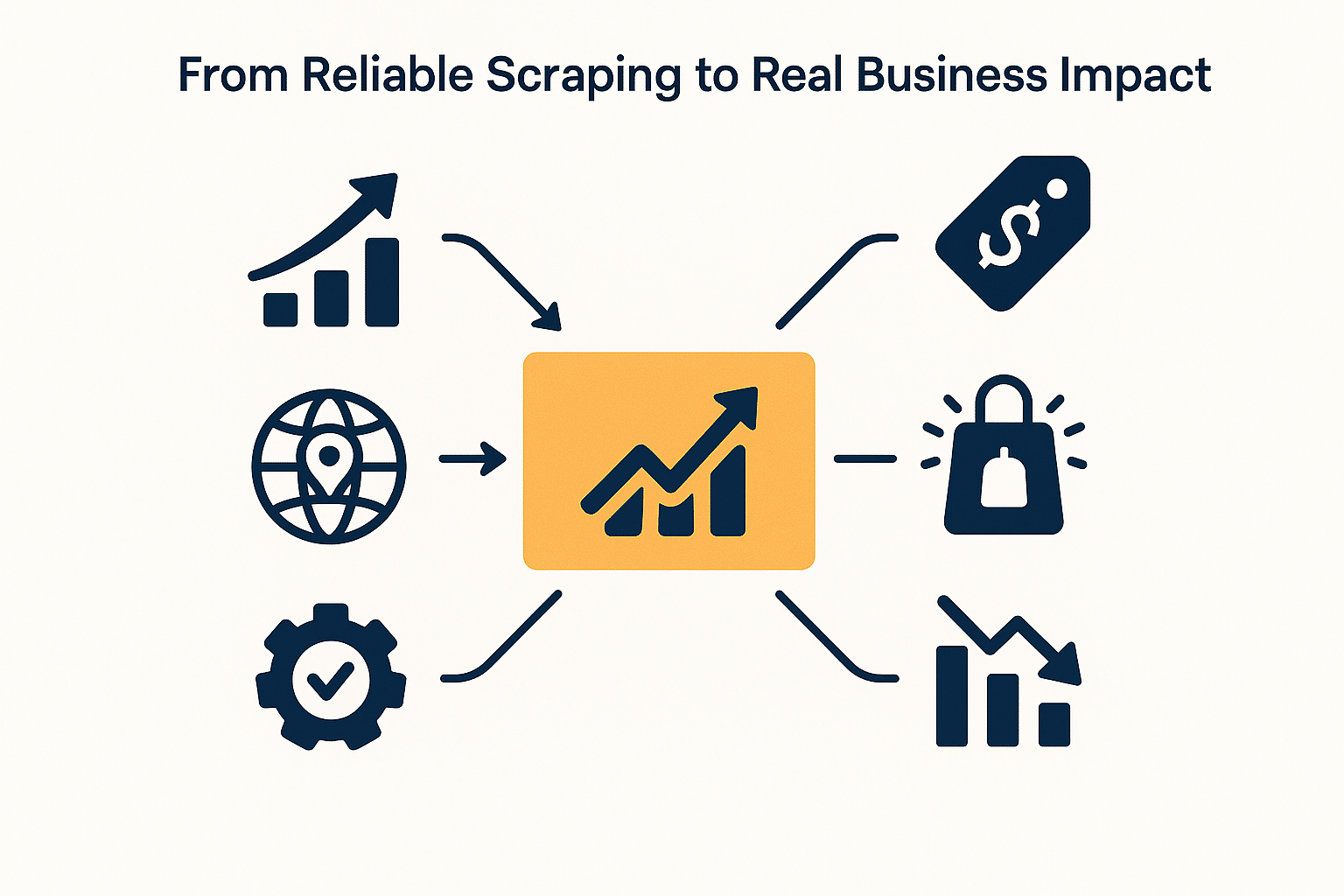
Real-Time Price Intelligence
React to competitor price changes immediately, not days later.
Stronger Shopping Ads Strategy
Understand how your listings appear compared to others, and optimize visibility.
Reduced Margin Leakage
Clean, reliable data prevents revenue loss from outdated or inaccurate pricing.
Lower Engineering Load
Dev teams stop fighting captchas and breakage, and start building durable pipelines.
Better Market Expansion Decisions
Geo-targeted insights help you identify regions ready for product entry or promotion.
Predictable Scaling
Stable infrastructure → predictable data → confident strategic decisions.
Why Businesses Choose RapidSeedbox for Seamless Google Shopping Scraping
Businesses choose RSB proxies because Google Shopping requires more than just IPs. It needs infrastructure that behaves like a real shopper and support teams who understand scraping inside out.
RapidSeedbox provides:
- Residential rotating proxies with region reliability
- Clean IP pools that reduce Captchas
- Transparent dashboards for control
- Real human engineers
- Test-first onboarding that proves the value before scaling
Ready to Scrape Google Shopping Results Reliably?
Accurate shopping data is key to pricing, demand forecasting, and market positioning. RapidSeedbox gives your team the infrastructure and support needed to maintain reliable, region-accurate scrapes.
FAQs
Collecting publicly visible data for analytics can be permissible, but must follow Google’s Terms and all applicable laws.
The shopping results can vary greatly from one region to another. This is because the IP addresses used can be incorrect, which leads to incorrect data.
Residential rotating proxies are the most reliable for Shopping modules.
Most pricing teams scrape hourly or daily, depending on market volatility.
Watch for empty Shopping grids, repeated page layouts, and sudden dips in complete cards.
Disclaimer: This content is for educational purposes only. RapidSeedbox does not encourage violating any website’s Terms of Service. Users are responsible for ensuring their scraping practices comply with applicable laws and policies.
0Comments