 By
By
Counterfeits. Fake social accounts. Hijacked ads. Unauthorized resellers. They chip away at brand trust one click at a time. This isn’t new—but it’s getting louder and harder to track by the day.
That’s where proxies come in. They let you see what your customers see, anywhere in the world (without waving the corporate flag). With rotating residential proxies and mobile proxies, your team can hunt down fakes and stay compliant. They will also learn how to move fast without tripping spam filters or firewalls. What used to be chaos, now it starts to make sense. Risk turns into data. And that data (if you use it right) becomes your best defense.
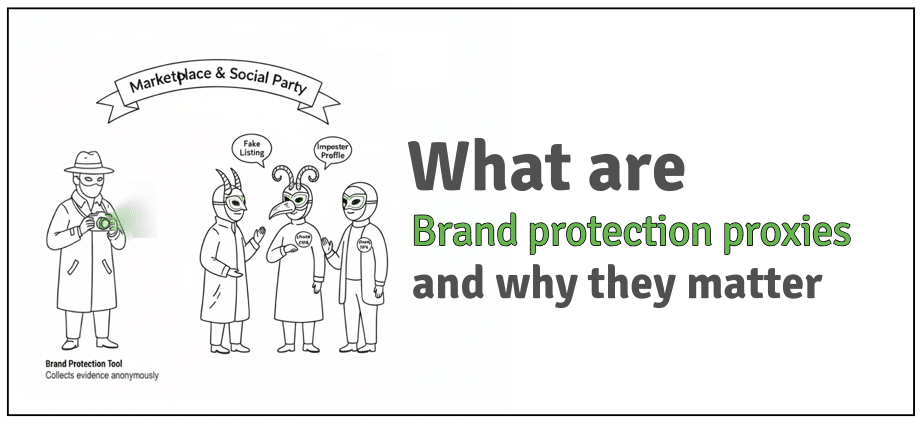
TL;DR — How Proxies Protect Your Brand
Before diving in, here’s the quick version.
- What Are Brand Protection Proxies (and Why They Matter): They’re proxy servers that mask your identity so your monitoring tools can detect counterfeits or scams without alerting bad actors.
- How Proxies Help Detect Counterfeit Products: By rotating residential IPs, you can safely scan marketplaces like Amazon, eBay, or Shopee for fake listings and capture solid evidence for takedowns.
- Social Media Monitoring and Impersonation Prevention: Use proxies to spot fake profiles, giveaway scams, or hijacked support pages—seeing platforms the same way real users do.
- Geographic and Competitive Intelligence: Residential and rotating proxies let you check how your brand appears worldwide and also track competitor pricing across regions.
- Security, Privacy, and Compliance in Brand Protection: Protecting your brand means respecting privacy laws too. Ethical proxy networks help you stay GDPR and CCPA compliant while monitoring safely.
- Choosing the Right Proxy Type for Brand Protection: Each proxy type has its place: residential for realism, datacenter for speed, mobile for social, and static ISP for stable logins.
- Top Proxy Providers for Brand Protection: A breakdown of leading providers like RapidSeedbox, Bright Data, and Oxylabs — which to pick depending on your team’s needs and scale.
- Best Practices & Common Challenges (with Fixes): Avoid bans and CAPTCHAs with smart rotation rules and geo-matching.
- Brand Protection Proxies: FAQ: Answers to common questions on legality, usage, compliance, and real-world setup tips.
Content Disclaimer: This article is for informational purposes only. It does not constitute legal, compliance, or cybersecurity advice. Readers are responsible for ensuring their brand protection activities comply with applicable laws, terms of service, and privacy regulations.
1. What Are Brand Protection Proxies (and Why They Matter)
Brand protection proxies are proxy servers (often large residential proxy networks) that route your traffic through masked IP addresses around the world. They give your monitoring tools anonymity and IP address masking so you can check marketplaces, search engines, and social networks without getting instantly blocked or identified as “the brand.”
Why should you care about brand protection proxies?
- Anonymity first. Investigate without tipping off bad actors.
- Real-world view. Load pages as a local user in any target city/country.
- Continuity. Rotate IPs to keep crawling even when sites rate-limit.
- Evidence. Gather clean screenshots/HTML reliably for takedowns.
Real world use cases:
Brand protection is built on real, daily data work. From tracking counterfeit sellers to spotting fake sites and bad ads, proxies make each task possible by masking your footprint and giving you clean, geo-specific access to what the public really sees.
- Counterfeit Detection & Seller Triage: Rotate residential IPs to sweep product terms and image matches across target marketplaces. Pull seller metadata, pricing, and review deltas to prioritize enforcements.
- Ad Verification & Brand Safety: Confirm your ads don’t show on harmful placements. Residential IPs expose geo-specific ad routes and misplacements.
- Unauthorized Resellers & MAP Audits: City-level IPs reveal regional under-MAP pricing and unauthorized channels. Trigger alerts and evidence packs for partner teams.
- Phishing & Fake Site Discovery: Crawl likely typo-domains and clone patterns. Capture full-page screenshots and SSL cert details behind proxies for legal action.
How brand protection works?
A brand protection proxy setup is like a stealth monitoring system. Below is a diagram that shows how proxy flows work to protect brands.
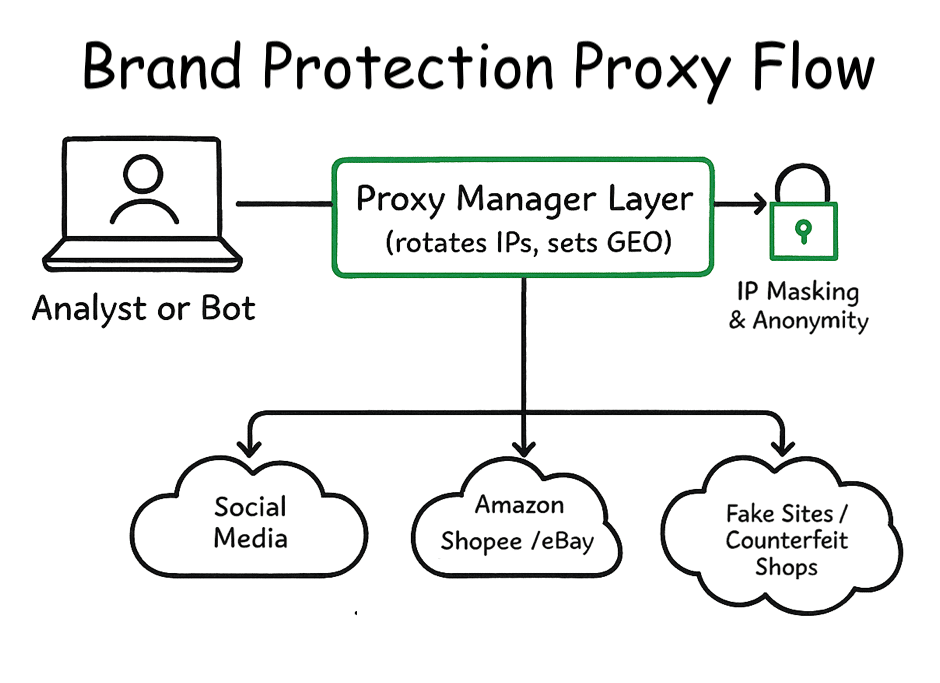
- The process starts with an Analyst or Bot (your brand protection tool) sending requests to various websites (e.g., Amazon, Shopee, fake shops, social media).
- Instead of connecting directly, every request passes through a Proxy Manager Layer, which rotates IPs and sets the GEO location.
- This manager pulls from a rotating residential proxy pool, so each request appears to come from a real user in a different region.
| The result? True IP masking and anonymity. Your monitoring activity looks natural and untraceable. |
2. How Proxies Help Detect Counterfeit Products
Counterfeiters thrive on e-commerce marketplaces and regional classifieds. To protect yourself, your team needs to scrape and collect data repeatedly: brand terms, model numbers, SKU images, price anomalies, seller histories.
How proxies make this work:
- Counterfeit detection at scale. Rotate through residential IPs to query product and seller pages without tripping anti-bot defenses.
- Marketplace parity checks. Compare your official listing vs. suspicious ones (title, imagery, pricing, ratings) across Amazon, eBay, AliExpress, Shopee, Mercado Libre, and niche platforms. Learn more about price intelligence: scraping Amazon and eBay intelligently.
- Visual similarity passes. Feed image URLs to your vision matcher; proxies fetch assets reliably (thumbnails, zooms, alt images).
- Evidence capture. Use headless browsers behind proxies to record screenshots, DOM copies, and seller IDs for legal escalation.
Real example patterns: One example: a “too-new” product at steep discount from a new seller → rotate proxies to fetch all variants and timestamps. Another example: a seller with repeated relistings after takedowns → track their reappearance using broader geo IPs (they often hide by region).
3. Social Media Monitoring and Impersonation Prevention
Impersonators spin up fake accounts (support, giveaways, warranty claims) to phish customers. In such cases, proxies can also help protect your brand. But how?
Social Media Proxies let you monitor social media without triggering platform friction or location biases.
What to do:
- Brand query sweeps. Rotate residential IPs to search your brand name, typo-variants, and hashtags across Facebook, Instagram, TikTok, X, YouTube, LinkedIn.
- Multi-account management. Use sticky (static) residential sessions to log into moderation or reporting dashboards that expect consistent IPs.
- Regional trend checks. Some keywords trend locally—country-specific IPs show you what locals see (and what impersonators may target).
Fake profiles can look legit…
Often so convincing that even your team might second-guess which one’s yours. Below is a simple side-by-side: what a real vs. fake profile looks like when you break down the details, handle, bio, links, etc.
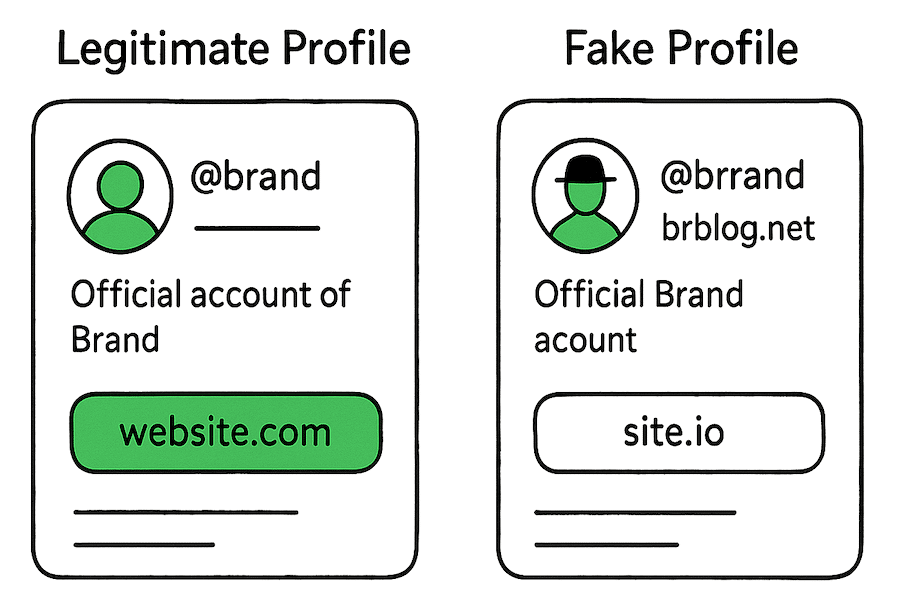
That’s where proxies help.
With residential or mobile proxies, your tools can safely scan for imposters using lookalike handles or copycat bios. Rotate IPs, see what users see, and catch the fakes before they fool anyone.
4. Geographic and Competitive Intelligence
Beyond infringement, marketing wants competitive clarity: localized search results, on-site personalization, promo calendars, and distribution leaks. Geo targeted proxies provide location-based monitoring so you can audit SERPs and competitor sites as a user in Tokyo, São Paulo, Berlin, or Cairo (not just from HQ.)
Use cases:
- Residential proxies to load location-specific SERPs for brand vs. competitor keywords.
- Rotating proxies to crawl competitor product pages (pricing, stock, bundles) without immediate bans.
- Channel integrity checks. Catch MAP violations and unauthorized resellers by city/region.
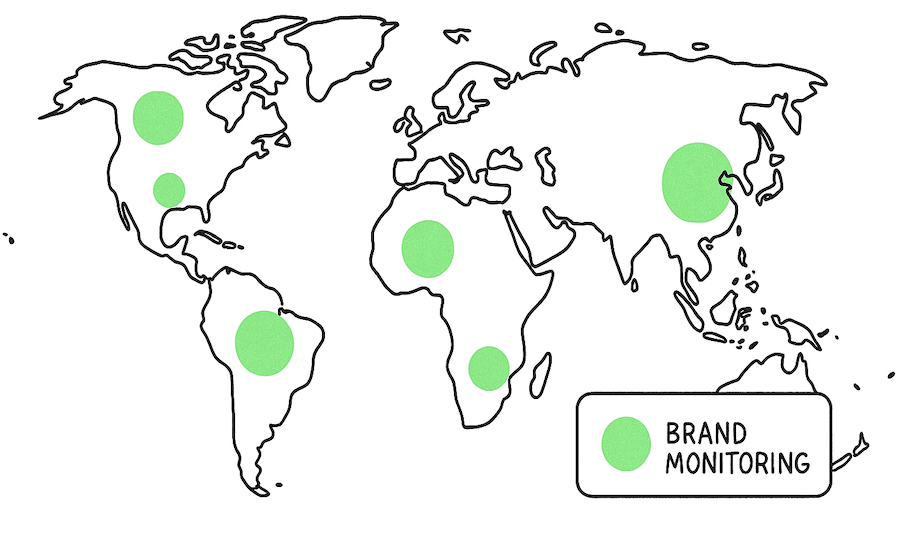
Global Brand Monitoring Heat Map
The heat map below shows how having global proxy coverage lets your brand monitoring efforts extend across continents. By routing requests through geo-specific residential IPs, teams can simulate real customer views from different regions—spotting localized counterfeit markets, ad discrepancies, or pricing inconsistencies that would otherwise stay hidden when browsing from headquarters.
This global visibility helps unify marketing and compliance efforts under one data-driven map.
5. Security, Privacy, and Compliance in Brand Protection
Modern brand protection is far more than just catching counterfeiters. But it’s also about doing it ethically, privately, and within the law.
As your global monitoring scales, your teams have to balance reach with responsibility. Every scrape and request leaves a digital trace. That trace needs to be both secure and compliant.
The best programs run on trust. They don’t just use proxies but they also use them right. And leaders care about the how as much as the what: Are the IPs ethically sourced? Are the analysts protected? Are laws like GDPR and CCPA respected? These are vital technical checks that can also safeguard your reputation.
Key principles to uphold:
- Ethical proxy networks: Choose providers that align with GDPR/CCPA and source IPs responsibly. Stick to public-web data and fair crawl rates.
- Data minimization: Collect only what’s needed. Set clear rules for retention and deletion.
- Encrypted transport: Use HTTPS and trusted proxy managers to secure both data and analysts.
- Policy alignment: Partner with Legal and Compliance early. Cover terms of use, disclosures, and cross-border rules.
| Bottom line: Brand protection is more than just collecting more data. It’s also about collecting responsibly. When security and compliance are baked in, trust follows. |
See What Your Customers See 🌍
Test your brand visibility from any country using rotating residential IPs — and reveal where imposters hide.
Try rotating view6. Choosing the Right Proxy Type for Brand Protection
Different jobs, different tools.
Use the following at-a-glance table to help you find and choose the right proxy for brand protection. Or you can also use the below quick proxy type picker.
Comparison Table
| Proxy Type | Best For | Strengths | Watch-outs |
| Residential | Marketplaces, social, SERPs | Real-user IPs → high success, low block rates; rich geo coverage | Higher cost per GB; slower than DC |
| Datacenter | Broad, low-sensitivity crawls | Fast, cost-efficient; great for bulk HTML on lenient sites | Easier to flag/ban; poor on anti-bot |
| Mobile (3G/4G/5G) | Social & mobile-first checks | “Human-like” IPs; tough to block | Premium pricing; limited concurrency |
| ISP / Static Residential | Sticky sessions, logins, dashboards | Stable identity; residential trust | Not ideal for high-churn crawling |
| Rotating Pools | Continuous monitoring, high-volume | Auto-rotation, fresh IPs; hands-off | Session continuity needs config |
Quick chooser (CTA-style):
- Need stealth on marketplaces/social? Start with Rotating Residential.
- Scanning lenient sites fast? Add Datacenter to reduce cost/GB.
- Mobile-first targets? Test Mobile IP routes for stubborn blocks.
- Consistent logins or dashboards? Use Static (ISP/Sticky) sessions.
7. Top Proxy Providers for Brand Protection
Here’s a TL;DR comparison table you can use, or continue reading for more information.
| Provider | Best For | Key Strength | Typical Pricing |
| RapidSeedbox | Hands-on brand monitoring | Easy setup, responsive support, rotating residential proxies | ~$2.00–$2.80/GB |
| Bright Data | Enterprise-scale monitoring | Massive IP pool, strong compliance tools | From ~$5.88/GB |
| Oxylabs | Advanced unblocking + managed setups | Web Unblocker, scraping APIs | Around ~$8/GB |
| NetNut | Broad geo coverage | Simple setup, 200+ countries | From ~$1.59/GB (enterprise tiers) |
| Rayobyte | Ethical sourcing focus | Ethically sourced IPs, trial access | From ~$0.90/GB |
⚡ Quick Take: RapidSeedbox wins for balance — affordable, straightforward, and easy to deploy without heavy API work.
a. RapidSeedbox (our pick for hands-on brand protection)

RapidSeedbox offers versatile proxy routes, including rotating residential, mobile, and datacenter options. What makes it stand out is the step-by-step onboarding, so you can easily drop into any existing monitoring stack. Digging into the numbers, the residential network lists 6.9M+ IPs with automatic rotation. This is ideal for stealth checks across marketplaces and social platforms. Pricing examples show competitive rates, ranging from $2.80/GB (10GB plan) down to $2.00/GB for larger 500GB packages.
b. Bright Data

Bright Data takes a more enterprise-focused approach, with a massive global IP pool and dedicated brand protection solutions built right in. As expected, that comes with a premium. Residential pricing starts at $5.88/GB, clearly positioning them as a top-tier option. That said, the platform shines in compliance tooling and performance dashboards. Plus it’s also often highlighted in independent reviews for reliability and scale. To explore more: Bright Data Proxy Alternative: 7 Best Options To Try
c. Oxylabs

If you need to bypass anti-bot defenses during brand audits, Oxylabs brings some heavyweight tools (especially its Web Unblocker and scraping APIs). Public pricing puts residential pay-as-you-go at around $8/GB, making them the most expensive. But they come with additional options for Web Unblocker tiers and trial access.
Explore for yourself: Oxylabs Review (+Alternatives)
d. NetNut
NetNut claims residential coverage in 200+ countries and offers a straightforward setup with helpful, content-driven onboarding.Pricing varies by tier, but third-party listings show rotating residential proxies starting around $1.59/GB at enterprise volumes. If you want practical docs and simple plans (minus the overhead of complex APIs) this could be a great match. Take a look here: NetNut Review [and Alternatives to Try in 2026]
e. Rayobyte

Rayobyte leads with a clear position on ethically sourced residential IPs — and they offer free trials so you can test before you commit. Their public pricing page lists residential rates “as low as $0.90/GB,” depending on volume. This provider is a strong option if ethical sourcing and tailored packages matter to your team. Just double-check regional availability for your markets. Learn more here: Rayobyte Proxy Review + 5 Better Alternatives (2026 Guide)
8. Best Practices & Common Challenges (with Fixes)
Running brand protection through proxies is about using your IPs smartly. The best setups should be able to mimic real users, while staying compliant and avoiding bans.
Below are proven tactics and common pitfalls (plus how to fix them fast).
- Rotate smart. Use time- or request-based rotation; don’t hammer one IP.
- Pitfall: IP bans/soft blocks from repetitive patterns or DC footprints.
- Fix: Prefer residential for sensitive targets, ramp slowly, diversify user agents, add cool-downs, mix GET/HEAD. (proxy rotation, scraping limits)
- Geo match every audit. Fetch from the market you’re checking (SERPs/marketplaces differ by location).
- Pitfall: Data quality gaps (missing listings, inconsistent fields).
- Fix: Multi-pass crawls (HTML + API-like flows), geo-retries, headless fallback, field validators. (data quality)
- Blend proxy types by task. Use rotating residential for discovery; sticky ISP for logins/evidence capture.
- Pitfall: Rotation misconfigurations causing lost sessions or login failures.
- Fix: Use sticky sessions during auth, scope cookies per session, rotate only between critical steps.
- Throttle & randomize. Humanize intervals, headers, and nav paths.
- Pitfall: CAPTCHAs & bot walls triggered by robotic behavior.
- Fix: Rotating residential, session cookies, modest concurrency; where allowed, solver APIs or rendering.
- Standardize evidence kits. Always store URL, timestamp, HTML, screenshots, seller ID, price, inventory notes.
- Pitfall: Legal & policy missteps (over-collection, private data, ToS conflicts).
- Fix: Crawl public pages only, align with Legal, document lawful basis, tighten retention. (legal restrictions, compliance)
| ⚠️ Reminder: You’ll never catch everything — but with steady, compliant coverage, you’ll catch enough to deter abuse. |
9. Brand Protection Proxies: FAQ
Proxies let you monitor websites anonymously, view geo-specific pages, and avoid IP blocks—so your team can detect counterfeit listings, fake sites, and impersonators reliably.
For sensitive targets (marketplaces/social), use rotating residential proxies for high success and stealth. Add static ISP sessions for logins; use datacenter for fast, lenient targets.
Yes—when you collect public web data responsibly, follow GDPR/CCPA obligations, and use ethically sourced proxies. Align with your Legal team on terms and retention. Learn more about the legalities of scraping.
They rotate IPs, throttle requests, and mimic normal browsing, which lowers bot-wall triggers. Pair with session management and rendering where necessary.
10. Final Thoughts
Brand protection is no longer a manual chase—it’s an automated, proxy-powered discipline. With the right mix of proxies, sensible automation, and clear compliance guardrails, you’ll spot more abuse, act faster, and protect reliability in the eyes of your customers.
Explore next:
- Rotating Proxies → how to configure time/request-based rotation for always-on crawls.
- Best Proxy Setup for Scraping → Learn the best tools and setup for scraping projects at scale.
Simplify Global Tracking 🌎
Manage regional profiles and pricing checks using mobile proxies with stable performance and anonymity.
Start clean tracking
0Comments