 By
By
❝Can’t access the data you need? You might be in the wrong country.❞
Geo-targeted proxies let you route traffic through real IPs in any country or city—giving your business local visibility without physical presence. This guide breaks down how CTOs use proxies for web scraping, ad verification, and QA testing while staying compliant. Learn which proxy types to choose, how to avoid legal risks, and which providers deliver the best geo-targeting at scale.
TL;DR / Table of Contents.
- What Are Geo-Targeted Proxies (And Why Do They Matter)? Route traffic through local IPs so sites treat you like a real user in that region.
- The 4 Ways To Use Geo-Targeted Proxies: Scrape regional data, verify ads, run localization QA, and gather clean market insights without blocks.
- Types of Geo-Targeted Proxies and How to Choose: Use residential for stealth, datacenter for speed, mobile for precision; match session behavior to the task.
- Choosing the Right Geo-Targeted Proxy Provider: What to Look For: Prioritize coverage, uptime, clean IP sourcing, compliance, useful tools, and real support over price.
- Top Geo-Targeted Proxy Providers: Snapshot of leading vendors and where each shines: city/carrier targeting, scale, or cost control.
- Legal & Ethical Best Practices for Geo-Targeted Proxies: Stick to public data, respect site rules, protect privacy, document processes, and avoid shady IPs.
- FAQ: Advanced Questions on Geo-Targeted Proxies: How to confirm city/ASN, choose mobile vs. residential, set sticky duration, pick HTTP vs. SOCKS5, and avoid fingerprints.
- Final Thoughts: Start small, test in target regions, and scale what works; act local to build global.
Disclaimer: This article is provided for informational and educational purposes only. While we strive to ensure accuracy, proxy laws and data compliance requirements can vary by region and use case. Always consult with a qualified legal or compliance professional before deploying geo-targeted proxies, especially for data scraping, ad verification, or testing in regulated markets. The mention of specific providers does not imply endorsement or guarantee of service quality. Use of any proxy service is at your own risk and responsibility.
1. What Are Geo-Targeted Proxies (And Why Do They Matter)?
You can think of geo-targeted proxies as teleporting your browser (without leaving your desk.)
Geo-targeted proxies are tools that route your internet traffic through an IP address in a specific location (country or city). To a website, it looks like your request is coming from that exact place.
These proxies don’t just spoof your IP, they make your traffic look like it’s coming from a real person in a specific place. Of course, not a cloud server. But a real user in Berlin, Buenos Aires, London, São Paulo or Bangkok. This gives you local visibility without physically being there.
⚡ What are the benefits?
- You can bypass location-based restrictions on content or services
- You will be able to view websites exactly as a local user would
- You will run region-specific tests, audits, or scrapes
- You will also avoid bans and blocks by mimicking real user behavior
How do geo-targeted proxies work?
As said before, geo-targeted proxies route your traffic through an IP address in a chosen country or city, so the target website sees you as a local user. Providers maintain pools of residential, datacenter, mobile, and ISP IPs tagged by location.
They operate on three layers:
- IP Allocation: Assigns you an IP registered in the target region.
- Traffic Forwarding: Routes your requests through that proxy node, masking your identity and delivering region-specific content.
- Session Management: Lets you choose between rotating IPs (ideal for scraping) or sticky/static sessions (best for logins and testing).
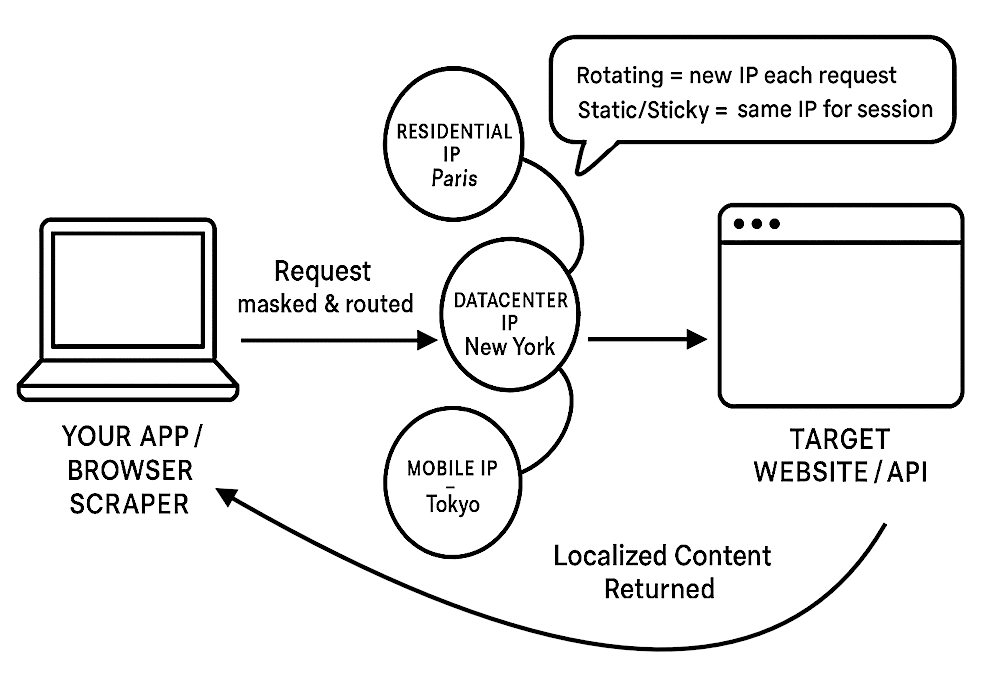
This setup enables businesses to access geo-restricted data, verify ads, and test localized apps without local infrastructure.
2. The 4 Ways To Use Geo-Targeted Proxies
Let’s get specific. Here’s how technical teams are putting geo-targeted proxies to work.
a. Web Scraping Across Regions
Scraping the same site from the U.S., UK, and Japan? Without proxies, you’ll hit blocks fast, or miss localized data entirely.
Geo-targeted proxies help you:
- Rotate IPs across cities or countries
- Collect real-time data like prices, availability, or reviews
- Avoid being flagged as a bot or blocked outright
Example: A travel site scrapes flight prices in multiple currencies using city-specific residential IPs.
| 🔑 Key takeaway: If your data isn’t geo-specific, it’s incomplete. |
b. Ad Verification & Local Campaign Testing
Want to know what real users see when your ads go live in different regions? You can’t trust VPNs or centralized tools to verify your ads, you should try geo-targeted proxies to help you with this. For example, your London ad might be showing in Chicago—and you’d never know without local verification.
Other reasons, why?
- See exactly which ads appear by city or ZIP
- Verify that geo-targeted campaigns are running correctly
- Detect ad fraud or spoofed placements
- Check compliance (e.g., alcohol ads only where legal)
| ⚡ Common mistake: Skipping city-level targeting. Country-level isn’t always enough. |
c. App Localization & QA Testing
Before your app goes global, you need to test how it performs globally. You can use geo-targeted proxies for this:
- Simulate users in specific regions or time zones
- Validate translated content and UX flows
- Trigger local banners, alerts, or legal notices (like GDPR)
- Run tests through mobile carriers (for real-world accuracy)
An example? A fintech app uses proxies in Quebec to confirm French language UI loads correctly.
| 👉 Testing globally? You need proxies that match real user environments. |
d. Market Research & Competitive Intelligence
Want to spy on your competitors (legally)? You’ll need to see what their users see. This is precisely where geo-targeted proxies come into play, with them you can:
- Analyze region-specific pricing, content, or offers
- Track local SEO performance in target cities
- Audit how your own website renders across regions
- Scrape public data without tipping off the target site
| 🔍 Pro Tip: Use rotating proxies to avoid detection and keep your sessions clean. |
3. Types of Geo-Targeted Proxies and How to Choose
When considering geo-targeted proxies, you’ll need to evaluate both the type of IP source and the way your sessions are managed.
Together, these determine cost and accuracy. And they also control the reliability for your use case.
Residential vs. Datacenter vs. Mobile: What’s the Difference?
| Proxy Type | Best For | Cost | Detection Risk | Geo Accuracy |
| Residential | Scraping, ad verification, sensitive tasks | High 💰 | Low ✅ | Very High 📍 |
| Datacenter | High-volume requests, dev testing | Low 💵 | Medium ⚠️ | Medium |
| Mobile | Mobile apps, carrier-level testing | Very High 🧨 | Very Low 🛡️ | Highest 🔥 |
- Residential proxies come from real consumer devices. They’re stealthy and accurate, but also the most expensive. Think of them as borrowing a real person’s Wi-Fi network.
- Datacenter proxies are fast and affordable (great for bulk or testing). But on the downside, these types of proxies are easier to detect. Like renting space in a server farm.
- Mobile proxies rely on 4G/5G carrier IPs. They’re almost unblockable and precise, but rare and costly. These proxies are like hitching a ride on someone’s mobile network.
Rotating vs. Static Proxies: Which Do You Need?
Beyond proxy type, the session behavior also matters. There are mainly two types of proxies’ session behavior management: rotation and static.
- 🔁 Rotating proxies: IP changes frequently (every request or interval).
- Best for volume scraping.
- Works when sites block repeat requests.
- Ensures stronger anonymity.
- 📌 Static proxies: IP stays the same for a session.
- Best for logins, accounts, or dashboards.
- Useful when stability is required.
- Safer on sites that flag frequent changes.
👉 But there is a third one! Many providers now offer sticky session proxies. These let you keep the same IP for minutes or hours before it rotates. It is a kind of hybrid model that covers most business workflows like ad verification and localized scraping.
See What Locals See 👀
Geo-targeted proxies let you access data like a real user in any region. Try it with rotating residential IPs.
Try Local Access4. Choosing the Right Geo-Targeted Proxy Provider: What to Look For:
Not all proxy providers are built the same. When trying to find the right geo-targeted proxy provider, it is always key to not just focus on getting the lowest price. You also need solid coverage, reliable performance, legal peace of mind, and room to grow.
Here’s a practical checklist to help you size up a vendor before signing anything:
a. Coverage: Can they reach where you need to go?
The best providers offer more than just a country-level option. With a good provider, you should be able to target by city and carrier. Look for access to residential, datacenter, ISP, and mobile proxies, ideally spread across 190+ countries. Global reach isn’t a bonus; it’s the baseline.
b. Scale & Performance: Will it hold up under pressure?
Check for concurrency limits and uptime guarantees. A strong provider should be able to handle unlimited threads, 99.9% uptime, and sub-second latency. If success rates don’t clear 99%, that’s a red flag.
c. Security & Privacy: Is your data (and theirs) protected?
You want HTTPS or SOCKS5 support. Also, consider encryption and minimal logging. Avoid networks that can’t confirm where their IPs come from. Free proxies? Forget about those. They are often laced with malware, hijacked devices, speed issues, or worst, unauthorized tracking. They’re not worth the risk. Learn more in: Paid Proxy Servers or Should You Get a Free Proxy?
d. Compliance & Ethics: Are they playing by the rules?
Make sure the provider uses ethically sourced IPs (like opt-in residential peers). If they highlight GDPR and CCPA compliance, even better. This is especially true if you’re operating in sensitive or regulated markets. Here is a real case: Hola’s free VPN ran as a peer-to-peer network. Free users’ devices/IPs were used as exit nodes; Hola then sold that crowd-sourced bandwidth via its sister business (then “Luminati”, now rebranded as BrightData). After backlash, Hola updated its FAQ to clarify this. Many critics argued this wasn’t a meaningful, explicit opt-in. Source: Forbes
e. Tools & Integrations: Will it save your team time?
The right provider bundles in extras: proxy APIs, session control, bandwidth tracking, even CAPTCHA bypass tools. These aren’t just bells and whistles, they can be really useful. They cut dev time and boost your ROI.
f. Support: Who’s got your back at 3 AM?
Things break. And when they do, you need fast help (not just a chatbot that takes days to reply). Look for 24/7 support, trial periods, money-back guarantees, and dedicated account managers. Bonus points if they offer free credits so you can test geo accuracy before scaling.
⚠️ Skip the free or sketchy stuff. Unverified proxies might look tempting, but they’re usually slow, unsafe, and a legal minefield.
| What’s the difference between VPNs and geo-targeted proxies? VPNs change your location for you. Proxies do it for your scripts, bots, or apps. |
5. Top Geo-Targeted Proxy Providers (2026)
| Provider | Targeting highlight | Best for |
| RapidSeedbox (Top) | City + carrier (mobile), 130+ countries; rotating/sticky | Precise geo-tests, stealth scraping |
| Bright Data | ZIP/city/carrier/ASN | Enterprise-scale scraping |
| Oxylabs | City/carrier/coords; sticky | Ad verification, tough geo |
| IPRoyal | City/ISP; PAYG | SMB / budget |
| Geonode | Country/city; cheap trial | Budget/local tests |
| Shifter | Geo; unlimited bandwidth | Heavy traffic loads |
a. RapidSeedbox (Best overall for precise geo-targeting)

RapidSeedbox leads with Mobile Proxies that support country → region → city and even carrier/ISP-level targeting across 130+ countries, using real 3G/4G/5G IPs with sticky or rotating sessions, and HTTP/SOCKS5. It claims 99.95% connection success and 99.9% uptime. This geo-targeted proxy provider is ideal for high-anonymity, location-accurate testing and scraping. Their Rotating Residential network adds 6.9M+ IPs in 100+ countries with automatic rotation and sticky options.
b. Bright Data

Bright Data advertises 150M+ residential IPs with country, city, carrier & ASN targeting and enterprise-grade tooling. This provider is strong when you need the broadest location granularity and ecosystem support.
Learn more in: Bright Data Proxy Alternative: 7 Best Options To Try
c. Oxylabs

Oxylabs’ residential pool lists 100M+ IPs on the product page with city-level targeting; its Mobile Proxies are sourced from real mobile carriers and allow targeting by country/state/city/coordinates/ASN. It comes with automatic rotation and up to 30-minute sticky sessions. A great choice for advanced geo tests and tougher targets.
Learn more in: Oxylabs Review (+Alternatives)
d. IPRoyal

IPRoyal offers 32M+ residential IPs in 195 countries with country/state/city targeting, unlimited concurrent sessions, and flexible pay-as-you-go pricing. A solid value for SMBs and budget-sensitive projects.
Learn more in: IPRoyal Review: Is it Worth a Shot?
e. Geonode

Geonode positions itself as a budget-friendly, developer-first option with a $5/10GB trial, claims of 190+ countries covered, ~500 ms average response, and an in-app configuration tool. A useful provider for low-cost, local tests when you don’t need massive pools.
Learn more in: Geonode: Defining Simple Proxy Server Pricing
f. Shifter

Shifter promotes a 31M+ residential pool and plans that include unlimited traffic for static residential proxies (rotating plans show large included traffic). It is an attractive choice for heavy, bandwidth-intensive scraping loads.
Learn more in: Shifter Review (+ Top Alternatives)
| 🧠 Tip: Start with a small plan or trial to validate geo accuracy (country/city/ISP) and success rates. It is also useful for seeing the session behavior (sticky vs. rotating) against your actual targets before scaling. |
6. ⚖️ Legal & Ethical Best Practices for Geo-Targeted Proxies
Geo-targeted proxies can reveal valuable insights (from tracking prices to verifying ads) but if you misuse them, you risk legal trouble and security blowback.
| Are geo-targeted proxies legal? Yes, but how you use them matters. Stick to public data and follow site terms. |
It is important that you lay down clear rules that balance data goals with legal and ethical standards. Here is what to do and what to avoid.
✅ What to Do:
- Stick to public data. Scrape what’s freely available — like product listings, prices, or reviews — and steer clear of anything behind logins or paywalls.
- Follow robots.txt when you can. Most sites share their automation rules. Respecting them reduces your chances of IP blocks or legal friction.
- Limit your request rate. Rotate your proxies and keep things throttled. It helps avoid server overloads and keeps bot detection at bay.
- Protect privacy. Don’t touch personal data unless you have clear consent. Privacy laws like GDPR and CCPA aren’t just for Europe or California — they have global reach.
- Keep a paper trail. Document your proxy sources, scraping practices, and compliance checks. If a legal question comes up, you’ll be ready.
❌ What to Avoid:
- Shady proxy sources. Free or underground proxies often tap hijacked devices or spread malware. Stick to trusted providers like Bright Data, Oxylabs, or IPRoyal — they focus on ethical sourcing and legal compliance.
- Over-the-line tactics. Stay away from credential stuffing, scraping private info, or dodging security features. These move you from smart research into risky territory.
- 💡 One quick gut check: If your setup feels shady, it probably is. Ethical, well-documented proxy use doesn’t just protect you — it works better, gets more support from providers, and scales cleanly with your business.
7. FAQ: Advanced Questions on Geo-Targeted Proxies
Cross-check MaxMind and IP2Location for city/ZIP/ASN, then render the target page to confirm localized UI/prices. Also test “what’s my IP” from inside your scraper. For newly US-routed IPv6, expect 14–30 days for databases to converge.
Use mobile proxies for the toughest targets, carrier-level tests, and fewer CAPTCHAs; choose rotating residential proxies for broad country/city coverage at scale and lower $/GB. Many teams mix both: mobile for logins/checkout, residential for bulk.
Start 5–15 minutes; extend only if needed. Keep a cookie jar, retry with backoff, and rebind to a new sticky IP on drop; cap concurrency and track session-drop rate.
HTTP is great for most scraping (header control); SOCKS5 fits mixed/non-HTTP traffic and app-store checks. Prevent DNS/WebRTC leaks so traffic doesn’t bypass your proxy.
Align UA, Accept-Language, time zone, and fonts; use headful/stealth in Playwright/Puppeteer; stabilize TLS/JA3; add jitter and moderate request bursts.
Many US DC ranges are country-only. Geo-DBs update on different cadences; after announce/route changes, allow 2–4 weeks—temporary mismatches are normal.
Estimate GB/job and add 10–20% overhead. Reduce usage with compression, conditional requests, caching/de-dupe, measured concurrency, and a backconnect gateway to reuse circuits.
8. Final Thoughts.
Geo-targeted proxies are essential if your team needs region-specific data without building infrastructure in every country. So, for example, you might be checking prices in Tokyo or testing an app in Montreal, proxies help you see what real users see. No need for flights or extra hardware.
In this article, we broke down the key proxy types and how to use them: rotate for scraping, go sticky for logins, and choose providers that offer strong coverage and clean IPs.
Done right, and geo-targeted proxies bring better data and more reliable testing.
Our final advice:
- Start small.
- Test a residential or mobile session in your target market.
- Then scale from there.
See What Mobile Sees 📲
Geo-targeted proxies from mobile carriers show what real users see on real devices — not server approximations.
View Our Proxies
0Comments