 By
By
Traditional SEO monitoring over IPv4 is usually the norm. But many people dont know it is expensive and often blocked. In this article we’ll discuss how an IPv6 proxy stack gives marketing and B2B teams cheaper and more reliable access to SEO data at scale. You’ll learn how IPv6 enables massive IP pools, stronger performance, and future-proof setups—plus the differences between residential and datacenter proxies, key SEO use cases, and hybrid strategies.
Table of Contents
- Introduction
- Why SEO Monitoring Demands IPv6
- The Business Benefits of IPv6
- Choosing the Right IPv6 Proxy Type
- Where IPv6 Proxies Shine in SEO
- Challenges and How to Handle Them
- Quick Answers (FAQ)
- Conclusion: IPv6 as the Future of SEO Monitoring
Content Disclaimer: This article is provided for informational purposes only. While every effort has been made to ensure accuracy, the content does not constitute technical, financial, or legal advice. Readers should consult qualified professionals before implementing strategies described here. The authors and publisher assume no liability for decisions made based on this content.
1. Introduction
The digital marketing game keeps changing. Still, SEO remains one of the toughest battlefields. How do you get reliable data from search engines — rankings, competitor moves, brand visibility? Getting this data has become both essential and expensive. Traditional proxy setups running on IPv4 are hitting a wall: IP shortages, rising costs, higher chances of blocks, and more.
But IPv6 changes the equation. With nearly unlimited addresses and lower operating costs, IPv6 proxies make large-scale SEO monitoring faster and cheaper. So, if your team is serious about search visibility, IPv6 is no longer, a nice-to-have. It’s the infrastructure upgrade that keeps data flowing at scale.
| 🤔 Did you know? IPv6 proxies significantly reduce blocking compared to IPv4 options. According to recent proxy data, IPv6 setups experience 40–70% fewer blocks than their IPv4 counterparts. Source: IPlocation |
2. Why SEO Monitoring Demands IPv6
Modern SEO is data-hungry. Tracking keywords across markets, monitoring competitors, collecting SERP results, and analyzing trends would generate millions of queries a day. Doing that on IPv4 is expensive and unreliable.
The Challenge:
IPv4 addresses are scarce, expensive, and often “dirty” from previous use—making them easier to flag. IPv6 removes those limits with a practically infinite pool of addresses. That means cleaner IPs and fewer bans. Plus better and cheaper scaling.
For marketing teams, the impact is simple: smoother rank tracking and more accurate competitor insights.
So, how IPv6 proxy steps in to help in SEO Monitoring?
The below diagram shows that SEO clients use their tools and bots, which in turn, send requests through an IPv6 proxy layer before reaching Google, Bing, and competitor websites.
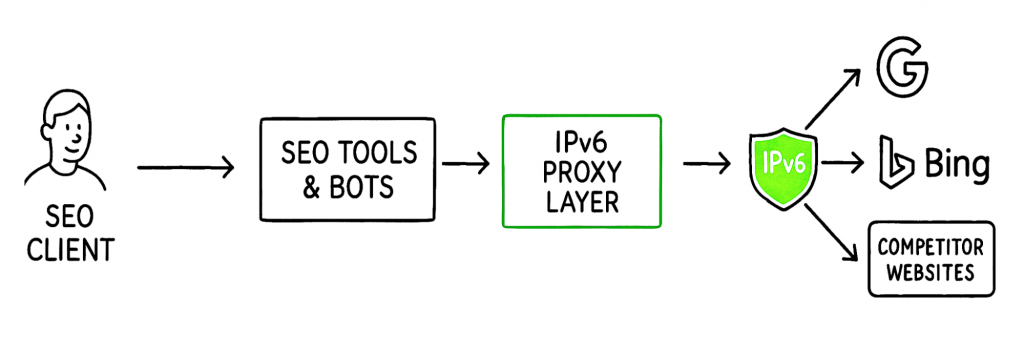
The result? This setup enables large-scale SEO tasks by using (and even rotating) countless IPv6 addresses. This is perfect for preventing blocks and ensuring smooth data collection.
Learn more about this topic in: The SEO Proxy: What is it and Why Do You Need it?
💡 Smarter Data Collection
Move past IPv4 restrictions—IPv6 proxy networks deliver cleaner, faster insights.
View Plans3. The Business Benefits of IPv6
When people hear “IPv6,” they usually think: “Oh it’s just another tech upgrade.” But in reality, especially for businesses, it’s a lot bigger than that. The move opens doors to scale, cut costs, improve performance and stay ahead of the curve.
Here’s why it matters:
- Massive IP pools: Instead of scraping by with a few hundred IPv4s, you get access to millions of fresh IPv6 addresses. That means, you wont run out of IPs and no more overusing the same IPs.
- Lower costs: IPv6 proxies cost up to 20× less (or more in some cases) than IPv4. What used to run thousands per month can often be done for a fraction of the price.
- Stronger performance: IPv6 is a new ‘better’ version of the IPv4. It was built to fix IPv4’s shortcomings. That means faster routing, built-in security, less congestion, and more reliable connections.
- Future-proofing: Here is some evidence: With over 40% of Google traffic already on IPv6 (Google IPv6 Adoption), the shift is happening. Early adopters avoid last-minute migrations and keep a competitive edge.
Add to that built-in IPsec encryption, and you also reduce security risks during data collection. For SEO teams, that is a difficult one to pass, when you are saving money, scaling faster, and getting cleaner, more accurate data.
4. Choosing the Right IPv6 Proxy Type
Not all proxies fit the same job.
The right choice depends on what you’re monitoring. Here is a quick comparison table for what is currently available in the IPv6 proxy market.
| Feature | Residential IPv6 | Datacenter IPv6 |
|---|---|---|
| Detection | Very low (looks like real users) | Easier to flag |
| Speed | Slower, variable | Very fast, stable |
| Cost | High ($$$) | Low ($) |
| Best For | Local SEO, ads, stealth | Rank tracking, bulk scraping |
- Residential IPv6 proxies look like normal home users, so they are harder to detect. Perfect for localized SEO checks and competitor tracking that needs authenticity—but they cost more and are far more rare in the market.
- Datacenter IPv6 proxies are faster and cheaper, ideal for bulk tasks like rank tracking or large-scale scraping. They’re less stealthy, but for sheer volume, they win on cost and speed.
- Hybrid setups. Although these are harder to build that are really the ones to often make the most sense. The idea woul be to use IPv6 for scale and keep IPv4 for sites that don’t yet support IPv6. Also mix residential with datacenter depending on the use case.
For most B2B teams, a hybrid or datacenter-first approach balances cost with reliability.
| 💡 Did you know? Residential IPv6 proxies can be up to 10x more expensive (and scarce) than datacenter IPv6 proxies—yet they’re far harder to detect. So, residential Ipv6 prozies are the best for localized SEO where authenticity matters. Learn more in: Residential vs Datacenter IPv6: The Differences. |
5. Where IPv6 Proxies Shine in SEO
IPv6 isn’t just cheaper—it opens up use cases that were previously hard or costly to manage.
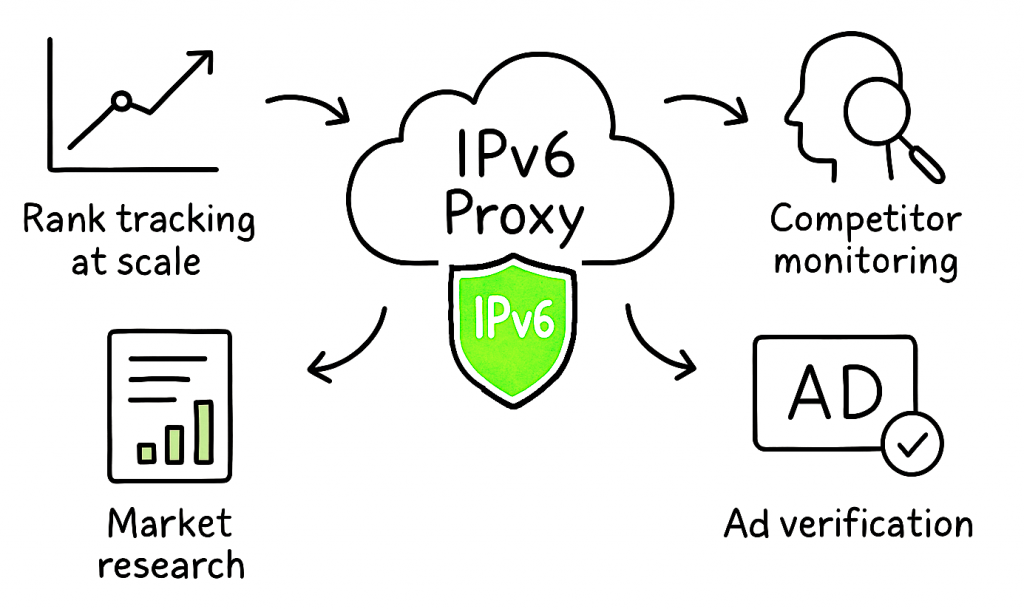
- Rank tracking at scale: Track thousands of keywords across countries and devices. Then layer in different times of day to see how results shift in real contexts. With IPv6 proxies, you can tap into massive address pools and capture SERP snapshots that mirror what users actually see across regions.
- Competitor monitoring: Watch how rivals price their products, position content, and roll out ads. Add to that their timing and market targeting, and you start to see the bigger strategy. Residential or datacenter IPv6 proxies help your activity blend in as organic traffic, so you can track updates in real time without triggering alarms.
- Ad verification: Make sure ads appear the way they should—not just on the right devices, but also across regions and platforms. IPv6 proxies let you step into a customer’s shoes, confirming targeting and spotting fraud while keeping your ad spend accountable.
- Market research: Pull keyword data, scrape SERPs, and track shifting trends. With IPv6 proxies, you can collect huge volumes of localized information without bans. That means sharper insights into consumer behavior and early signals of new niches before competitors catch on.
6. Challenges and How to Handle Them
IPv6 isn’t perfect. Some websites and tools still rely on IPv4, and not every SEO platform is ready for IPv6. That can create gaps in coverage. The fix is straightforward: run a dual-stack setup that supports both IPv4 and IPv6. Most modern proxy providers already do this, automatically routing requests through the right protocol.
Another challenge is managing huge pools of IPs—sometimes millions. Manual oversight here is impossible, but advanced proxy management platforms handle rotation, monitoring, control, and failover for you. In practice, that complexity stays hidden, and your team gets cleaner and more reliable data.
There’s also the question of tool compatibility. Some older SEO platforms default to IPv4 connections, even when IPv6 is available. To avoid surprises, test your core SEO tools for IPv6 readiness before committing. Many leading providers are catching up quickly, but planning ahead ensures you can fully benefit from the scale and cost advantages IPv6 brings.
7. IPv6 Proxy for SEO: Quick Answers (FAQ)
For scale and cost, datacenter IPv6 proxies are the sweet spot. For authenticity, residential IPv6 is worth the premium.
No. They’re unreliable, shared, and risky. Professional SEO needs stable, private proxies.
Yes, at least for now. Some sites still don’t support IPv6. Hybrid setups give you full coverage.
Massive IP diversity reduces bans, geographic targeting improves local data, and cleaner addresses mean fewer false blocks.
Conclusion: IPv6 as the Future of SEO Monitoring
IPv6 is the next foundation of SEO monitoring. Moving now, will get your business, immediate wins in cost savings and scale. Plus, you are also preparing for a future where IPv6 rules.
The math is simple:
- Up to 80–95% cost savings compared to IPv4
- Nearly endless IP diversity,
- Stronger resilience under load.
- Cleaner IP reputation with fewer false blocks
- Geo-targeting flexibility for hyper-local SERP checks
Those savings and efficiencies can be reinvested into broader monitoring or deeper analysis.
Bottom line? IPv6 proxies help marketing teams gather larger datasets and do it more consistently. On top of that, they cut costs. For B2B brands competing in crowded search markets, this is the way to stay ready for what’s next.
📊 Scale SEO Without Limits
Track thousands of keywords and competitors at scale using IPv6 proxy infrastructure.
Start Scaling
0Comments